 LaddoThis
Bengali Hindu wedding ceremonies, in order
A Bengali Hindu wedding usually moves through 11 ceremonies: Aashirbaad, Ai Buro Bhaat, Vriddhi & Nandi Mukh, Dodhi Mangal & Gaye Holud, Bibaho, Bidaai, Bodhu Boron & Bashor Ghor, Bashi Biye, Bou Bhaat, Phool Shojja and Dira Gaman. Below is each one in order, when it usually happens and what it means. Customs vary between families and regions, so treat this as the common sequence, not a rule.
11 ceremonies127 checklist tasks in the app
At a glance
- 3-6 Months BeforeAashirbaad আশীর্বাদThe blessing and engagement ceremony
- 3-5 Days BeforeAi Buro Bhaat আইবুড়ো ভাতThe last bachelor/bachelorette feast
- Vriddhi & Nandi Mukh বৃদ্ধি ও নান্দীমুখThe ancestor blessing ceremony
- Wedding Day — MorningDodhi Mangal & Gaye Holud দধি মঙ্গলWedding morning rituals — dawn meal, river invitation, bangles, and turmeric
- Bibaho বিবাহThe sacred Bengali Hindu wedding ceremony
- Wedding Night & Day AfterBidaai বিদায়The bride's emotional farewell
- Bodhu Boron & Bashor Ghor বধূ বরণ ও বাসর ঘরBride's welcome at groom's home and first-night ceremonies
- Post-WeddingBashi Biye বাসি বিয়েThe morning-after ceremony — sindoor reapplication and games
- Bou Bhaat বৌ ভাতThe bride's reception — cooking rice for her new family
- Phool Shojja ফুল শয্যাThe flower bed night
- Dira Gaman দিরা গমনThe bride's first return to her parents' home
Aashirbaad আশীর্বাদ
3-6 Months Before
The blessing and engagement ceremony
Aashirbaad is the Bengali engagement — though traditionally no rings are exchanged. Instead, future in-laws bless the bride and groom with dhaan (husked rice), durba (trefoil grass), gold ornaments, new clothes, and sweets. Elders from both families touch the couple's foreheads with these auspicious items while chanting blessings.
There are usually two separate Aashirbaad events — one at the bride's home (Patro Aashirbaad by the groom's family) and one at the groom's home (Kone Aashirbaad by the bride's family). At each event, the visiting family brings elaborate Tatva — beautifully decorated gift trays containing sarees, jewelry, sweets, fruits, dry fruits, decorated fish, and cosmetics.
Modern families often add a ring exchange on top of the traditional rituals.
Why it matters
Aashirbaad symbolizes the formal acceptance and blessing of the union by both extended families. Gold ornaments represent prosperity and continuity of family wealth. Husked rice and durba grass are Vedic symbols of fertility and eternal life. The decorated fish is uniquely Bengali — fish is the most auspicious food in Bengali culture.
In LaddoThis: a Aashirbaad checklist with 16 tasks, 11 of them things to buy or prepare.
Ai Buro Bhaat আইবুড়ো ভাত
3-5 Days Before
The last bachelor/bachelorette feast
Ai Buro Bhaat is one of the most anticipated pre-wedding events. Held separately at each home 1-3 days before the wedding, it is a grand feast where the mother cooks the bride or groom's absolute favourite dishes.
The spread includes the full glory of Bengali cuisine — multiple fish preparations, mutton kosha, various vegetables, rice, dal, chutneys, and an elaborate dessert spread of payesh, rosogolla, sandesh, and more. The bride or groom sits at the centre of attention, dressed in fine clothes, served by family members.
It is deeply emotional — the mother feeds her child one last meal before their life changes forever. In modern celebrations, it often includes music, dancing, and can be combined with mehndi.
Why it matters
Food holds an almost sacred place in Bengali culture. The "last meal" symbolizes the end of carefree days in one's parental home. For the mother, it is a profoundly emotional act of love — preparing her child's favourite dishes one final time.
In LaddoThis: a Ai Buro Bhaat checklist with 9 tasks, 3 of them things to buy or prepare.
Vriddhi & Nandi Mukh বৃদ্ধি ও নান্দীমুখ
3-5 Days Before
The ancestor blessing ceremony
Vriddhi and Nandi Mukh are companion rituals honouring departed ancestors. The priest performs an elaborate puja at both homes, invoking the spirits of seven ancestral generations along with Lord Narayan. Vedic mantras are chanted, incense fills the air, and offerings are made to the sacred fire.
The father or paternal guardian makes offerings on behalf of the family. This ceremony resembles a Shraddh (ancestral remembrance) but is joyful — it is a Nandi (happy) Mukh (face), inviting ancestors to witness and bless the union with happy faces.
The turmeric paste prepared during this ritual is later used in the Gaye Holud ceremony.
Why it matters
Bengali Hindus believe marriage is not just a union of two individuals but of two lineages stretching back generations. By invoking ancestors, the family acknowledges that their blessings are essential for the marriage's success. The ritual reminds the couple they carry the legacy and values of their forebears.
In LaddoThis: a Vriddhi & Nandi Mukh checklist with 9 tasks, 8 of them things to buy or prepare.
Dodhi Mangal & Gaye Holud দধি মঙ্গল
Wedding Day — Morning
Wedding morning rituals — dawn meal, river invitation, bangles, and turmeric
These rituals begin before sunrise on the wedding day.
In Dodhi Mangal, the bride and groom are woken early and served dodhi (sweet yogurt), khoi (puffed rice), chira (flattened rice), banana, and sweets — their only food until after the ceremony, as both fast out of respect for Agni.
For Ganga Nimontron, the bride's mother proceeds to the nearest river with married women, carrying brass pots, betel leaves, turmeric, and lamps, blowing conch shells to invite Goddess Ganga's blessings and collect sacred water.
During Sankha Porano, seven married women adorn the bride's wrists with Sankha (white conch shell bangles) and Pola (red lac bangles) — the quintessential markers of a married Bengali Hindu woman.
In Gaye Holud, seven or nine married women grind fresh turmeric with mustard oil. It is applied to the groom first, then the remaining paste is sent to the bride's home in a silver bowl along with Tatto gift trays containing the bridal saree, jewelry, cosmetics, decorated fish, and sweets. The bride is anointed with this same turmeric — creating a symbolic connection — and bathed with the sacred river water.
Why it matters
Dodhi Mangal ensures the couple enters their sacred day nourished but ready to sacrifice comfort through fasting. Ganga Nimontron brings the most sacred river's blessings into the wedding. The shared turmeric in Gaye Holud physically connects bride and groom through the same paste — symbolizing purification and intertwined destiny. Turmeric also gives the skin a golden glow.
In LaddoThis: a Dodhi Mangal & Gaye Holud checklist with 19 tasks, 15 of them things to buy or prepare.
Bibaho বিবাহ
The sacred Bengali Hindu wedding ceremony
The main Bengali wedding is a grand, multi-hour ceremony at the mandap (chadnatola).
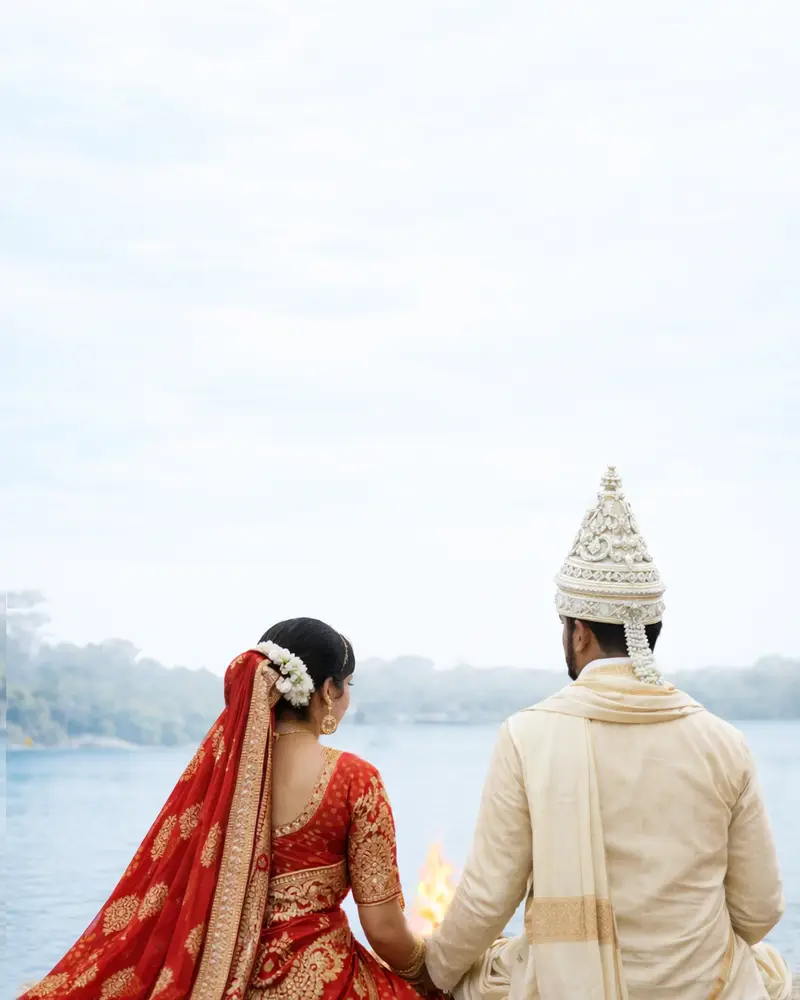
The groom arrives wearing a Topor (pith crown) and Dorpon (mirror charm). The bride's mother welcomes him with ululation, conch shells, and the Baran Dala. He changes into Potto Bastra from the bride's maternal uncle.
In Saat Paak, the bride enters on a Piri (wooden stool) holding betel leaves over her face. Brothers carry her around the groom seven times. At Subho Drishti, she lowers the leaves — their eyes meet for the first time. The couple exchanges garlands three times (Mala Badal).
For Sampradan, the bride's father places her hand into the groom's. The priest ties their hands with sacred thread before the sacred fire. In Saptapadi, the couple takes seven steps around the fire, each a vow — nourishment, strength, health, happiness, progeny, longevity, and eternal friendship. The bride steps on a stone pestle at each round.
In Anjali, the bride's brother places puffed rice in her hands, offered together to the fire. The groom applies sindoor to the bride's hair parting, and a relative drapes the Lajja Bastra over her head, completing the marriage.
Why it matters
Every element carries layered meaning: the fire is the divine witness to vows binding for seven lifetimes; the garland exchange signifies mutual choice; the father giving away the bride represents the most generous gift in Hindu tradition; the sindoor transforms the bride's social identity. The ceremony is notable for its relative simplicity in decoration but profound depth in ritual meaning.
In LaddoThis: a Bibaho checklist with 30 tasks, 19 of them things to buy or prepare.
Bidaai বিদায়
Wedding Night & Day After
The bride's emotional farewell
After the ceremony and feast, the bride prepares to leave for the groom's home. Both seek blessings from elders by touching their feet. A bamboo winnow containing oil lamps, an egg, sindoor, and betel leaves is touched to the foreheads of both bride and groom. Married women perform ululation and blow conch shells.
The bride throws handfuls of puffed rice over her shoulder — her mother catches them in her saree pallu. This symbolizes the bride repaying her debt to her parents and wishing prosperity upon the home she is leaving.
The bride walks to the decorated car accompanied by the groom and a few relatives (konyajatri — the bride's escort party). It is a moment of tears, bittersweet joy, and profound transition.
Why it matters
Bidaai represents the pivotal moment of transition — the bride leaves her natal family. The rice throwing is both gratitude (returning the grain that nourished her) and a blessing for her parents' continued prosperity. It is the moment that most consistently moves everyone to tears at a Bengali wedding.
In LaddoThis: a Bidaai checklist with 5 tasks, 3 of them things to buy or prepare.
Bodhu Boron & Bashor Ghor বধূ বরণ ও বাসর ঘর
Wedding Night & Day After
Bride's welcome at groom's home and first-night ceremonies
When the couple arrives at the groom's home, the mother-in-law and female relatives welcome them. Water is poured from a brass pitcher under the car for purification. The groom's mother performs aarti at the entrance.
The bride dips her feet in alta (red lac dye) mixed with milk and rose petals, then walks across a white cloth — leaving red footprints symbolizing the entry of Goddess Lakshmi (prosperity) into the home. She is offered milk in an earthen pot to watch overflow (symbol of abundance). The mother-in-law performs "Bou Bhari" — both sit on her lap as she declares the bride is heavier.
--- Kaal Ratri ---
Surprisingly, the newlyweds are separated for this first night. The bride sleeps in one room (with a female relative), the groom in another. Songs and celebrations continue.
--- Bashor Ghor ---
The following night, the couple enters the bridal chamber together. The bride's sisters guard the door, demanding a cash ransom from the groom. Inside, the couple plays games — finding rings in opaque milk, untying knotted strings, answering fun questions.
Why it matters
Bodhu Boron transforms the bride from a visitor to a daughter of the house. The Lakshmi-like footprints carry deep symbolism — the bride brings prosperity and fortune. Kaal Ratri serves as a buffer allowing the bride to adjust emotionally. Bashor Ghor creates a playful, low-pressure environment for bonding.
In LaddoThis: a Bodhu Boron & Bashor Ghor checklist with 11 tasks, 9 of them things to buy or prepare.
Bashi Biye বাসি বিয়ে
Post-Wedding
The morning-after ceremony — sindoor reapplication and games
Bashi Biye ("stale wedding") takes place the morning after. The groom reapplies sindoor to the bride's forehead and hair parting, reaffirming the vows. The couple is bathed with holy water and receives blessings from all elders.
Playful traditional games follow: the Ring Fishing Game where a ring is placed in a bowl of opaque milk with saffron and petals — whoever finds it first "dominates" the marriage; the Fish Catching Game where the bride retrieves a live fish from a bucket; and the Topor-Mukut Water Test where headgear tips are placed in swirling water to predict "who follows whom."
The bride receives new gifts and clothes from the groom's family.
Why it matters
The reapplication of sindoor the day after serves as a second confirmation that the union is permanent. The games help the bride, who may be overwhelmed, to laugh, relax, and begin forming bonds with her new family through humour and shared experience.
In LaddoThis: a Bashi Biye checklist with 7 tasks, 6 of them things to buy or prepare.
Bou Bhaat বৌ ভাত
Post-Wedding
The bride's reception — cooking rice for her new family
Bou Bhaat is the Bengali reception, held 1-3 days after the wedding. It begins with the Bhat Kapor ritual — the groom presents his bride with a new saree, sindoor, and a full plate of food. This is his formal promise to provide for her.
The bride then ceremonially cooks her first meal in her new home — traditionally payesh (rice pudding) or ghee rice — and serves every family member starting with elders. This act symbolizes her full acceptance into the household.
In the evening, a grand banquet is held. The couple is seated on a decorated stage as guests queue to bless them and present gifts (often cash or gold). The bride's family attends as konyajatri, bringing their own Tatva trays. An elaborate Bengali feast is served — multiple fish preparations, mutton, rice, dal, vegetables, chutneys, and a lavish sweet spread.
Why it matters
By cooking rice for the household, the bride enacts the most fundamental act of Bengali domestic life — feeding the family. Rice (bhaat) is the soul of Bengali cuisine; by serving it, the bride takes her place as a provider and nurturer. The reception also introduces the bride to the groom's extended social circle.
In LaddoThis: a Bou Bhaat checklist with 14 tasks, 7 of them things to buy or prepare.
Phool Shojja ফুল শয্যা
Post-Wedding
The flower bed night
Phool Shojja takes place on the second night after the bride's arrival. The groom's family decorates the marital bedroom lavishly with fresh flowers — jasmine, rose petals, tuberose, and marigolds. The room is scented with floral arrangements, candles, and soft lighting.
The bride wears floral jewelry (flower bracelets, garlands, hair ornaments). The couple is escorted to the room by female relatives amid teasing and lighthearted banter. Cousins and sisters linger at the door making jokes before finally leaving them in privacy.
Why it matters
The flowers represent new beginnings, beauty, fertility, and the blossoming of love. By creating a room overflowing with nature's most beautiful creations, the family creates a sacred, beautiful space — a recognition that physical intimacy is a blessed part of married life.
In LaddoThis: a Phool Shojja checklist with 4 tasks, 3 of them things to buy or prepare.
Dira Gaman দিরা গমন
Post-Wedding
The bride's first return to her parents' home
Dira Gaman typically occurs a few days to two weeks after the wedding. The couple travels to the bride's parental home for the first time since the Bidaai. It is a joyous reunion — the bride's family hosts them with a festive meal and celebration.
The sacred thread (raksha sutra) tied on the bride's wrist during the ceremony is formally cut, symbolizing the completion of wedding rites. The bride's family prepares a lavish Bengali meal, and the couple receives gifts and blessings. They may stay for a day or several days.
Why it matters
Dira Gaman reassures the bride and her family that marriage does not sever the bond with her natal home. The cutting of the sacred thread marks formal closure of the wedding rituals, signalling the couple is fully established in married life.
In LaddoThis: a Dira Gaman checklist with 3 tasks, 2 of them things to buy or prepare.