 LaddoThis
Gujarati Hindu wedding ceremonies, in order
A Gujarati Hindu wedding usually moves through 12 ceremonies: Chandlo Matli & Gol Dhana, Ganesh Sthapana & Grah Shanti, Pithi, Mameru, Mehndi, Garba & Sangeet, Varghodo & Ponkhvu, Wedding Ceremony, Vidaai, Griha Pravesh, Reception and Pag Phera. Below is each one in order, when it usually happens and what it means. Customs vary between families and regions, so treat this as the common sequence, not a rule.
12 ceremonies127 checklist tasks in the app
At a glance
- 6+ Months BeforeChandlo Matli & Gol Dhana ચાંદલો માટલીThe engagement — vermillion mark, sweets, and jaggery-coriander distribution
- 1-2 Days BeforeGanesh Sthapana & Grah Shanti ગણેશ સ્થાપનાInstalling Lord Ganesha and planetary blessings for an obstacle-free wedding
- Pithi પીઠીThe turmeric ceremony for purification and glow
- Mameru મામેરુંThe maternal uncle's gifts — including the sacred Panetar saree
- 3-5 Days BeforeMehndi મેહંદીThe henna ceremony with music and dance
- Garba & Sangeet ગરબા અને સંગીતThe vibrant night of Garba, Dandiya, and performances
- Wedding DayVarghodo & Ponkhvu વરઘોડો અને પોંખવુંThe groom's procession and welcome at the venue
- Wedding Ceremony લગ્ન વિધિThe sacred Gujarati Hindu wedding ceremony
- Vidaai વિદાઈThe bride's emotional farewell
- Post-WeddingGriha Pravesh ગૃહ પ્રવેશThe bride enters her new home as Goddess Lakshmi
- Reception રિસેપ્શનThe grand celebration hosted by the groom's family
- Pag Phera પગ ફેરાThe bride's first return to her parents' home
Chandlo Matli & Gol Dhana ચાંદલો માટલી
6+ Months Before
The engagement — vermillion mark, sweets, and jaggery-coriander distribution
Chandlo Matli is the first ceremony in a Gujarati wedding. The bride's father, accompanied by four male family members, visits the groom's home. He applies a Chandlo (vermillion mark) on the groom's forehead, blesses him, and offers shagun. A matli (steel or silver utensil) filled with sweets is presented. Five married women from the bride's side participate in applying the chandlo. The wedding date is fixed.
--- Gol Dhana (Engagement) ---
Often combined with Chandlo Matli, the Gol Dhana ceremony is the formal engagement. "Gol Dhana" means jaggery and coriander seeds — both distributed among guests as symbols of sweetness and prosperity. The couple exchanges rings. The groom's mother presents the bride with jewelry (necklace, bangles, earrings, anklets) and clothes. The bride's brother applies tilak on the groom and presents a coconut. The event concludes with a traditional Gujarati feast.
Why it matters
The Chandlo (vermillion mark) is a sign of acceptance of the union by both families. Jaggery represents sweetness in the new relationship, while coriander seeds symbolize prosperity. This is the first occasion where both families formally come together and bond.
In LaddoThis: a Chandlo Matli & Gol Dhana checklist with 16 tasks, 11 of them things to buy or prepare.
Ganesh Sthapana & Grah Shanti ગણેશ સ્થાપના
1-2 Days Before
Installing Lord Ganesha and planetary blessings for an obstacle-free wedding
Ganesh Sthapana marks the spiritual beginning of the wedding. Both families install a Ganesh idol at their homes and pray for a happy married life. The bride's brother, along with male cousins, visits the groom's family bearing a Ganesh idol and matlis filled with sweets. Ganesha — the remover of obstacles — is invited to be present throughout the wedding.
--- Mandap Mahurat ---
Both families worship the land where the mandap will be set up, asking Mother Earth's permission. A Manek Stambh (decorative wooden pillar) is placed in the soil. In modern celebrations, a decorative pot with soil may substitute.
--- Grah Shanti ---
The planetary puja follows immediately. The priest performs individual shlokas for all nine planets (Navagraha), seeking peace, protection, and removal of any obstacles. This ceremony is considered mandatory in Gujarati weddings and lasts 1-2 hours.
Why it matters
Ganesha is universally revered as Vighnaharta — the remover of obstacles. The Grah Shanti reflects the deep Gujarati belief in astrology. By seeking blessings from all nine planets, families ensure no astrological hurdles appear in the couple's married life.
In LaddoThis: a Ganesh Sthapana & Grah Shanti checklist with 14 tasks, 12 of them things to buy or prepare.
Pithi પીઠી
1-2 Days Before
The turmeric ceremony for purification and glow
Pithi is the Gujarati Haldi ceremony, performed separately at both homes the day before the wedding. The bride or groom sits on a Bajoth (low seat). The Kaki (paternal uncle's wife) prepares the pithi paste — sandalwood powder, turmeric, rosewater, mogra perfume, and herbs.
The decorated platter is blessed by the priest. Close family members take turns applying the paste to the bride/groom's face, hands, and feet. The ceremony begins with prayer and lamp lighting, and ends with music, dancing, and festivity. After the application, the bride/groom takes a holy bath.
Why it matters
Turmeric is revered in Hinduism for its antiseptic and purifying qualities. It cleanses the skin and brings a natural glow. The yellow hue symbolizes joy, prosperity, and new beginnings. There is a fun belief that if the pithi is applied to an unmarried person, they will be the next to marry.
In LaddoThis: a Pithi checklist with 11 tasks, 9 of them things to buy or prepare.
Mameru મામેરું
1-2 Days Before
The maternal uncle's gifts — including the sacred Panetar saree
Mameru is one of the most heartfelt Gujarati ceremonies. The bride's maternal uncle (Mama) and aunt's husband (Mousa) visit the bride's home 1-2 days before the wedding, bringing a plethora of gifts in beautifully decorated gift trays.
The most significant gift is the Panetar saree — a traditional white and red silk saree that the bride wears during the wedding ceremony. The Panetar has red/maroon borders with a white or cream body, often in Gajji silk with bandhani and zari work. Other gifts include jewelry, cream/white chura (marriage bangles), sweets, dry fruits, and other auspicious items.
Note: The Gharchola saree (a bandhani tie-dye in red/maroon with gold zari) is a separate gift from the groom's mother. The bride traditionally wears the Panetar for the first half of the ceremony and changes into the Gharchola for the second half, symbolizing her transition from one family to the other.
Why it matters
Mameru demonstrates the close-knit nature of Gujarati families and the special bond between the bride and her maternal family. The Panetar's combination of white (purity, peace) and red (love, fertility) is associated with Goddess Durga — the epitome of feminine strength.
In LaddoThis: a Mameru checklist with 6 tasks, 5 of them things to buy or prepare.
Mehndi મેહંદી
3-5 Days Before
The henna ceremony with music and dance
Mehndi is held at the bride's home 2-3 days before the wedding. All the women — sisters, cousins, friends, and relatives — assemble for intricate henna application. The bride receives the most elaborate designs on both hands and feet, with the groom's initials hidden within the patterns.
The ceremony features live music, dance performances, and entertainment. The bride's close ones showcase choreographed dances while older women sing folk wedding tunes. Decorations are bright and colourful — marigolds, drapes, and fairy lights.
Why it matters
Mehndi is believed to bring good luck and is a symbol of joy and beauty. The deeper the colour, the deeper the love between the couple, according to tradition. It provides a joyous occasion for the women to bond before the wedding.
In LaddoThis: a Mehndi checklist with 8 tasks, 2 of them things to buy or prepare.
Garba & Sangeet ગરબા અને સંગીત
3-5 Days Before
The vibrant night of Garba, Dandiya, and performances
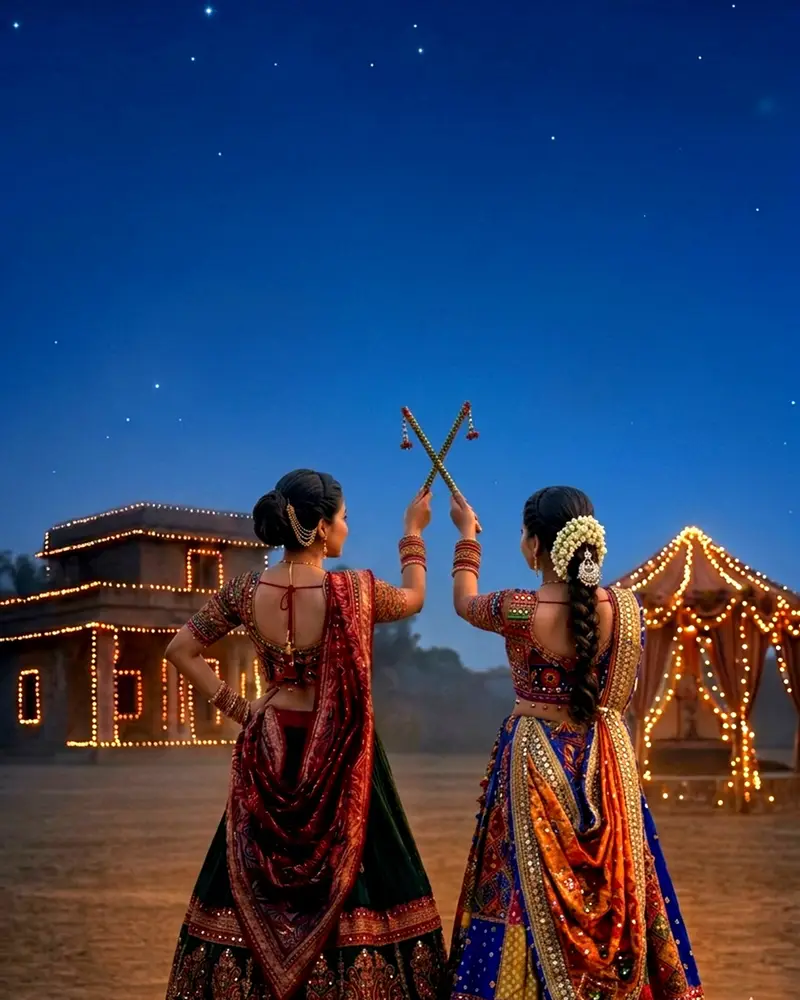
The Garba is the quintessential Gujarati celebration, usually held the evening before the wedding. Garba is the folk dance of Gujarat — synchronized spinning and clapping in an ever-rotating circle. Dandiya Raas features pairs dancing with decorated sticks.
The evening includes choreographed Sangeet performances, traditional Garba-Raas circles, skits, and entertainment. Women wear Chaniya Choli; men wear Kurta. Dhol performers add to the atmosphere. This is often the largest and most energetic event of the entire wedding.
Both families perform choreographed numbers, and the evening is the real beginning of the festivities — the first occasion for both families to bond in a relaxed, joyful setting.
Why it matters
Garba is deeply rooted in Gujarati culture, traditionally performed during Navratri to honour Goddess Durga. Its inclusion in weddings brings the spirit of devotion, community, and celebration. Dandiya Raas represents the mock fight between Goddess Durga and the demon Mahishasura.
In LaddoThis: a Garba & Sangeet checklist with 11 tasks, 3 of them things to buy or prepare.
Varghodo & Ponkhvu વરઘોડો અને પોંખવું
Wedding Day
The groom's procession and welcome at the venue
The wedding day begins with the Varghodo — the groom's procession. At his home, his sister waves a bowl of coins around his head (the coin sounds ward off evil spirits and remind the brother not to forget his family). The groom, on a decorated horse and accompanied by a band, dances through the streets to the venue.
--- Ponkhvu ---
At the venue, the bride's mother leads the welcome: she performs aarti, applies tilak on the groom's forehead, and feeds him sweets. Then comes the playful Ponkhvu tradition — the bride's mother attempts to pull the groom's nose in jest, reminding him to be humble. The groom tries to escape. This gets everyone laughing and breaks the formality between the families.
Why it matters
The Varghodo represents the groom's journey to claim his bride. The sister's coin ritual reinforces family bonds and provides spiritual protection. The Ponkhvu nose-pulling tradition establishes warmth between the families and reminds the groom that humility is valued.
In LaddoThis: a Varghodo & Ponkhvu checklist with 11 tasks, 8 of them things to buy or prepare.
Wedding Ceremony લગ્ન વિધિ
The sacred Gujarati Hindu wedding ceremony
The mandap ceremony encompasses sequential rituals lasting 1.5-3 hours.
In the Antarpat, a cloth is held between the couple; the curtain drops and their eyes meet. They exchange garlands (Jaimala) amid playful interference from friends.
During Kanyadaan, the bride's father places her hand in the groom's while the mother pours sacred water. In Madhuparka, the groom's feet are washed and he is offered Panchamrut, while sisters hide his shoes for ransom.
For Hasta Milap & Mangal Pheras, the priest ties the groom's shawl to the bride's pallu. Gujarati weddings have four pheras around the sacred fire — the groom leads three, the bride leads the fourth, representing equal partnership. Each phera represents Dharma, Artha, Kama, and Moksha. The bride's brother offers puffed rice into the fire.
In Saptapadi, the bride touches seven betel nuts with her right toe while reciting seven vows.
The groom applies sindoor and ties the mangalsutra. The couple feeds each other Kansar — their first act as spouses. The bride changes from her Panetar into the Gharchola from the groom's mother, symbolizing her transition. Seven married women bless them: "Saubhagyavati Bhava."
Why it matters
The four pheras represent the four pillars of Hindu married life: Dharma, Artha, Kama, and Moksha. The bride leading the fourth phera is uniquely Gujarati — representing harmony and equal partnership. The Antarpat drop is the dramatic emotional centrepiece. The transition from Panetar to Gharchola saree physically embodies the bride's journey from one family to the other.
In LaddoThis: a Wedding Ceremony checklist with 26 tasks, 19 of them things to buy or prepare.
Vidaai વિદાઈ
Wedding Day
The bride's emotional farewell
After the ceremony and feast, the bride bids farewell to her parental home. She takes rice in her hands and throws it backward over her head without looking — her mother catches the rice in her saree pallu. This represents the bride settling her debts to her family and wishing them continued prosperity.
The ceremony is filled with tears, embraces, and mixed emotions. It marks the bride's departure from her childhood home to begin her new life. She is escorted to a decorated car by her brothers.
Why it matters
The Vidaai acknowledges the bittersweet nature of a daughter's departure. The rice symbolizes prosperity and the repayment of the parents' love and sacrifice. It is both sorrowful and celebratory.
In LaddoThis: a Vidaai checklist with 5 tasks, 3 of them things to buy or prepare.
Griha Pravesh ગૃહ પ્રવેશ
Post-Wedding
The bride enters her new home as Goddess Lakshmi
The bride is welcomed at the groom's home by her mother-in-law, who performs aarti. A vessel filled with rice grains (kalash) is placed at the entrance. The bride enters by pushing the grain-filled pot with her right foot, spilling the grains inward — the new Lakshmi brings prosperity into the home.
--- Aeki Beki ---
A playful post-wedding game follows. A large vessel is filled with milk, vermillion, water, coins, and a gold ring. The couple searches for the ring using only their right hands. Whoever finds it four out of seven times is said to "rule the household." The winner receives a token gift.
Why it matters
The bride is seen as Goddess Lakshmi entering the household, bringing fortune and blessings. The spilling of grains symbolizes abundance. The Aeki Beki game lightens the mood after the emotional Vidaai and helps the couple bond.
In LaddoThis: a Griha Pravesh checklist with 5 tasks, 4 of them things to buy or prepare.
Reception રિસેપ્શન
Post-Wedding
The grand celebration hosted by the groom's family
The reception is traditionally hosted by the groom's family. Both families bless the couple, enjoy a feast, and celebrate. The event includes the couple's first dance, cake cutting, speeches, performances, and a mix of Bollywood and contemporary music.
This brings together the wider circle of friends, colleagues, and extended family who may not have attended the intimate ceremonies. Some brides opt for a Western gown for the reception.
Why it matters
The reception marks the public celebration of the union and allows the wider community to share in the couple's joy. It is where the couple begins their married life surrounded by blessings from all.
In LaddoThis: a Reception checklist with 9 tasks, 4 of them things to buy or prepare.
Pag Phera પગ ફેરા
Post-Wedding
The bride's first return to her parents' home
Pag Phera — "the bride's homecoming" — takes place 3-4 days after the wedding. The bride's brothers escort her back to her parents' home. She is received with open arms, garlands, and a small aarti. A festive meal is prepared. Sweets are exchanged between families.
The bride typically stays for about three days. When the visit ends, the groom comes to seek blessings and takes his bride back.
Why it matters
Girls are considered a form of Goddess Lakshmi — the bride's return ensures continued prosperity for her parents. Pag Phera reinforces family bonds and assures the bride that she always has a home with her parents.
In LaddoThis: a Pag Phera checklist with 5 tasks, 3 of them things to buy or prepare.