 LaddoThis
Indian Muslim (North Indian) wedding ceremonies, in order
A Indian Muslim (North Indian) wedding usually moves through 14 ceremonies: Istikhara, Mangni, Mehendi, Manjha, Sanchaq, Nikah, Arsi Mushaf, Rukhsati, Walima, Chauthi, Sehra Bandi, Qawwali Night, Dua-e-Khair and Salami & Reception at Groom's Home. Below is each one in order, when it usually happens and what it means. Customs vary between families and regions, so treat this as the common sequence, not a rule.
14 ceremonies123 checklist tasks in the app
At a glance
- 6+ Months BeforeIstikhara استخارہSeeking divine guidance before committing to the match
- 3-4 Months BeforeMangni منگنیThe formal engagement ceremony
- 3-5 Days BeforeMehendi مہندیThe vibrant henna ceremony with music and dance
- Manjha مانجھاThe turmeric purification ceremony
- Sanchaq سنچقGifts from the groom's family delivered to the bride
- Nikah DayNikah نکاحThe sacred Islamic marriage contract ceremony
- Arsi Mushaf آرسی مصحفThe mirror and Quran ceremony — the couple's first look
- Rukhsati رخصتیThe emotional farewell as the bride departs
- After NikahWalima ولیمہThe grand wedding feast hosted by the groom's family
- Post-WeddingChauthi چوتھیThe bride's first return to her parents' home on the fourth day
- Nikah DaySehra Bandi سہرا بندیThe groom is dressed and the baraat procession begins
- 3-5 Days BeforeQawwali Night قوّالیAn evening of devotional Sufi music
- 1-2 Days BeforeDua-e-Khair دعائے خیرA prayer gathering seeking blessings for the couple
- After NikahSalami & Reception at Groom's Home سلامیThe bride is welcomed to the groom's home and given gifts
Istikhara استخارہ
6+ Months Before
Seeking divine guidance before committing to the match
Istikhara is the very first step in a North Indian Muslim wedding. Before families agree to a match, one or both families perform Salat al-Istikhara — a special prayer seeking Allah's guidance on whether the proposed union is right.
The prayer is typically performed after the Isha (night) prayer. The person praying recites two rakaats of nafl (voluntary) prayer followed by a specific dua asking Allah to guide the decision if it is good, or turn hearts away from it if it is not. The prayer may be performed over several consecutive nights.
Family elders, and sometimes a trusted Maulvi, are consulted as well. The decision is based on a combination of prayer, spiritual signs, and practical family discussions. Once Istikhara yields a positive feeling, the families proceed to the engagement.
Why it matters
Istikhara reflects the deep Islamic belief that marriage is ordained by Allah and that humans should seek divine counsel before making life-changing commitments. It ensures the union begins with tawakkul (trust in God) and prevents hasty decisions driven purely by worldly considerations.
In LaddoThis: a Istikhara checklist with 4 tasks, 1 of them things to buy or prepare.
Mangni منگنی
3-4 Months Before
The formal engagement ceremony
Mangni (also called Nishaan in some North Indian Muslim families) is the formal engagement ceremony that publicly announces the match. It is a festive gathering of both families where the commitment to marry is sealed.
The ceremony typically begins with a recitation from the Quran and a dua for blessings. The bride and groom exchange rings — in many traditional families, this is done through female intermediaries since the couple may not yet be in the same room. Both families exchange beautifully decorated trays (thaals) filled with sweets, dry fruits, and gifts.
The groom's family presents the bride with jewellery and clothing, while the bride's family reciprocates with an outfit and gifts for the groom. Elders from both sides offer blessings and salami (cash gifts). Sweets are distributed to the extended family and community to formally announce the engagement.
Why it matters
Mangni marks the public declaration of intent to marry. After this ceremony, both families consider the match settled and begin wedding preparations in earnest. It strengthens the bond between the two families and allows the wider community to share in the joy.
In LaddoThis: a Mangni checklist with 11 tasks, 7 of them things to buy or prepare.
Mehendi مہندی
3-5 Days Before
The vibrant henna ceremony with music and dance
The Mehendi ceremony is one of the most colourful and joyful pre-wedding celebrations in a North Indian Muslim wedding. Held one to two days before the Nikah, it is a festive gathering where intricate henna designs are applied to the bride's hands, arms, and feet.
The bride sits in a decorated area — traditionally surrounded by cushions, flowers, and colourful drapes — while a professional artist applies elaborate designs that can take three to five hours. The groom's initials or name are hidden within the intricate patterns for him to find later. Female relatives and friends also get henna applied.
The celebration is filled with music, dancing, and singing. In North Indian Muslim families, a mix of traditional Bollywood songs and folk melodies accompany the festivities. Lavish snacks — chaat, kebabs, and biryani — are served throughout. Modern Mehendi functions often feature choreographed dance performances by friends and cousins.
Why it matters
Mehendi is considered sunnah (a practice of the Prophet, peace be upon him) and is believed to bring barakat (blessings) to the marriage. It is also believed that the darker the henna stains, the stronger the bond between husband and wife. The ritual has deep roots in Mughal court culture, where elaborate henna art was a symbol of celebration and beauty.
In LaddoThis: a Mehendi checklist with 11 tasks, 4 of them things to buy or prepare.
Manjha مانجھا
3-5 Days Before
The turmeric purification ceremony
Manjha (also called Ubtan or Haldi in some North Indian Muslim families) is a pre-wedding purification ceremony held a day or two before the Nikah. Both families perform it separately at their own homes.
The bride or groom is dressed in yellow finery and seated on a decorated chowki (low stool). A paste made of turmeric, sandalwood powder, and rose water is prepared. The bride's or groom's mother applies the paste first, followed by aunts, cousins, and friends. Each woman takes her turn, often playfully smearing extra paste on the bride/groom and on each other, turning the ceremony into a joyful, messy celebration.
Women of the family sing traditional folk songs (geet) to the beat of a dholak while the ubtan is applied. After the ceremony, the bride or groom is not supposed to leave the house until the wedding day. The ubtan is washed off with rose water, leaving the skin glowing.
Why it matters
The turmeric paste is believed to purify the body and soul, ward off the evil eye (nazar), and give the skin a natural bridal glow. The ritual marks the beginning of the bride or groom's transformation into their married self. The restriction on leaving the house afterwards symbolizes a period of sanctity before the Nikah.
In LaddoThis: a Manjha checklist with 8 tasks, 7 of them things to buy or prepare.
Sanchaq سنچق
3-5 Days Before
Gifts from the groom's family delivered to the bride
Sanchaq is a beloved pre-wedding ritual in North Indian Muslim weddings, typically held one to two days before the Nikah. Members of the groom's family — usually led by the groom's mother and sisters — visit the bride's home bearing beautifully arranged gifts.
The centrepiece of the Sanchaq is the bridal outfit that the bride will wear on the day of the Nikah. This is carefully chosen by the groom's family and presented along with matching jewellery, perfume (attar), cosmetics, shoes (khussas), and toiletries. The gifts are displayed on elaborately decorated trays, often covered with embroidered cloths and adorned with flowers.
Alongside the bridal ensemble, trays of sweets, dry fruits, and fresh fruits are also sent. The bride's family welcomes the visiting party with refreshments and hospitality. The occasion is marked by warmth and excitement as the women from both families bond over the upcoming wedding.
Why it matters
Sanchaq signifies the groom's family's formal acceptance of the bride and their commitment to caring for her. By providing her wedding outfit and adornments, they symbolically begin their responsibility toward her even before the Nikah. It is also a gesture of love, generosity, and welcome.
In LaddoThis: a Sanchaq checklist with 10 tasks, 9 of them things to buy or prepare.
Nikah نکاح
Nikah Day
The sacred Islamic marriage contract ceremony
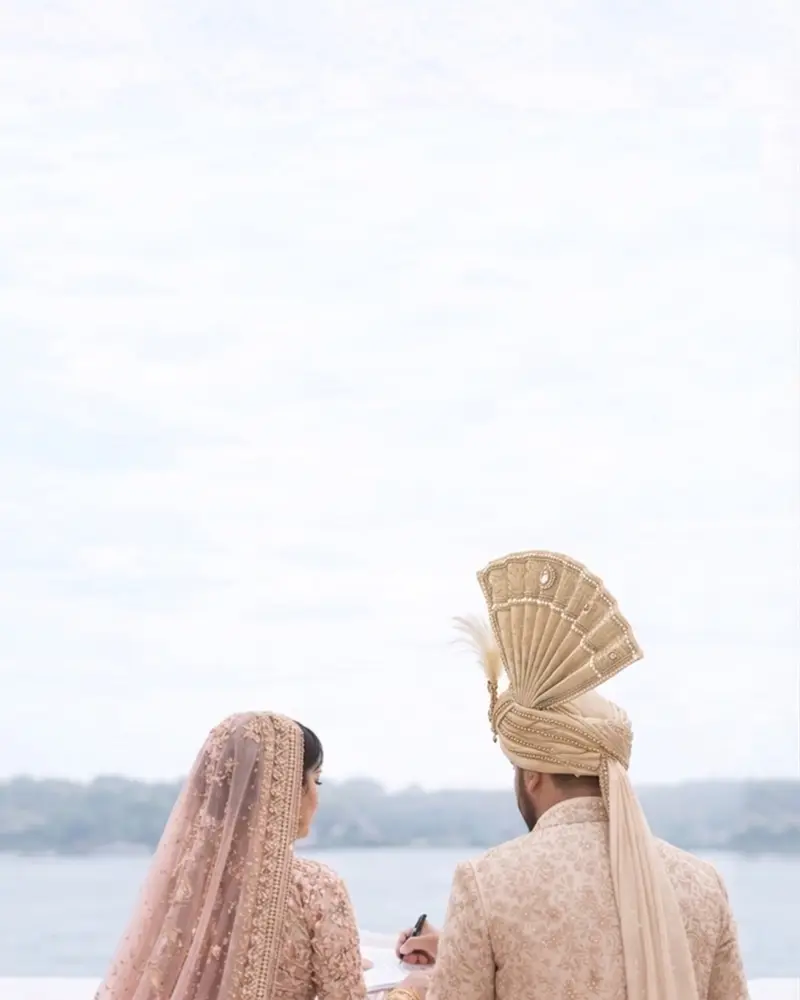
The Nikah is the heart of a North Indian Muslim wedding — the solemn Islamic marriage contract that binds the couple in the eyes of Allah and the law. It is officiated by a Qazi or Maulvi and follows the Shariah framework of Ijab (proposal) and Qubool (acceptance).
The ceremony begins with a Khutba-e-Nikah — a sermon by the Qazi including Quranic verses and Hadith on the sanctity of marriage. The Mahr (dower) — an obligatory gift from the groom to the bride — is formally announced. It is the bride's exclusive right.
The Qazi asks the groom three times: "Do you accept this marriage?" The groom responds "Qubool hai" (I accept) each time. The bride is asked the same, either directly or through her wali (guardian), and also says "Qubool hai" three times. Two adult male Muslim witnesses must be present for validity.
The Nikah-Nama (marriage contract) is signed by the bride, groom, witnesses, and the Qazi. Dates are distributed to guests, and a dua is offered for the couple. A grand feast — often featuring Lucknowi biryani, korma, and an array of kebabs — follows.
--- Joota Chupai (جوتا چھپائی) ---
When the groom removes his shoes before sitting for the Nikah, the bride's sisters and cousins steal and hide them. After the ceremony, when it is time to leave, the groom discovers his shoes are missing. The bride's sisters demand a cash ransom — hilarious negotiations ensue before the groom's side pays up and the shoes are returned with much laughter.
Why it matters
In Islam, Nikah is not merely a ceremony but a sacred contract (aqd) that establishes mutual rights and responsibilities between husband and wife. The Mahr protects the bride's financial independence. The Qubool must be given freely — consent is a cornerstone of Islamic marriage. The Nikah is both a spiritual bond before Allah and a legal contract recognized by society.
Joota Chupai breaks the ice between the groom and his new in-laws — a playful tradition that builds a warm, teasing bond between the groom and the bride's sisters.
In LaddoThis: a Nikah checklist with 18 tasks, 9 of them things to buy or prepare.
Arsi Mushaf آرسی مصحف
Nikah Day
The mirror and Quran ceremony — the couple's first look
Arsi Mushaf is one of the most tender and intimate rituals of a North Indian Muslim wedding, especially prevalent in families of Awadhi (Lucknow) origin. It takes place immediately after the Nikah is solemnized.
The newly married couple is seated together, and a large dupatta or shawl is draped over both their heads, creating a private canopy. A small mirror is placed between them, and a copy of the Holy Quran is placed on top of the mirror. The couple gazes at each other's reflection in the mirror — this is traditionally the first time they see each other as husband and wife.
The groom may trace the Surah Ikhlas (a short chapter of the Quran affirming the oneness of Allah) with his finger on the bride's forehead. They then read Quranic verses together while still covered by the dupatta. When the shawl is finally removed, the couple sees each other directly, and the moment is met with joy and blessings from those gathered around.
Why it matters
The mirror symbolizes reflection and truth — the couple sees themselves as a united pair for the first time. The Quran placed above the mirror signifies that their union is under the protection and guidance of Allah. The Surah Ikhlas on the forehead represents a prayer for spiritual purity. This ritual is especially cherished in Awadhi and Lucknowi Muslim traditions.
In LaddoThis: a Arsi Mushaf checklist with 5 tasks, 3 of them things to buy or prepare.
Rukhsati رخصتی
Nikah Day
The emotional farewell as the bride departs
Rukhsati is the most emotionally charged moment of a North Indian Muslim wedding. It is the formal farewell of the bride as she leaves her parental home to begin her new life with her husband.
After the Nikah feast, the bride prepares to depart. She embraces her parents, siblings, grandparents, and family members one by one in an emotional goodbye. Tears flow freely as the reality of the departure sinks in. The bride's father or brother recites a dua for her protection and happiness.
As the bride steps out, the Holy Quran is held above her head — a gesture of divine protection as she transitions to her new home. The bride is guided to the decorated car by her brothers or close male relatives. Family members and friends shower blessings and prayers.
Why it matters
Rukhsati marks the beginning of the bride's new chapter. The Quran held over her head symbolizes that she leaves under the protection of Allah. The farewell is bittersweet — joyful because she is married, sorrowful because she is leaving home. In Islamic tradition, the bride's departure should be with dignity, love, and prayer.
In LaddoThis: a Rukhsati checklist with 8 tasks, 6 of them things to buy or prepare.
Walima ولیمہ
After Nikah
The grand wedding feast hosted by the groom's family
Walima is the grand wedding reception and feast hosted by the groom's family, typically held the day after the Nikah or within a few days. It is a sunnah of the Prophet Muhammad (peace be upon him) and is considered an essential part of the wedding celebrations.
The couple makes a grand entrance and is seated on a beautifully decorated stage. Guests line up to congratulate the newlyweds, offer blessings (duas), and present gifts — typically cash in envelopes (salami). A lavish dinner is served, often featuring Mughlai and Lucknowi cuisine: biryani, nihari, korma, a variety of kebabs (seekh, galouti, shami), naan, and an array of desserts including sheer khurma, phirni, and gulab jamun.
The evening features music, sometimes a Qawwali performance, and socializing. Modern Walima receptions also include DJ music, dance performances, and photo booths. It is the public declaration of the marriage to the wider community.
Why it matters
The Walima is a sunnah — the Prophet Muhammad (peace be upon him) said: "The worst of food is the food of a Walima to which the rich are invited and the poor are left out." It is meant to be inclusive and generous. The feast publicly announces the marriage and allows the community to share in the joy. It is the groom's family's way of honouring their new daughter-in-law.
In LaddoThis: a Walima checklist with 11 tasks, 4 of them things to buy or prepare.
Chauthi چوتھی
Post-Wedding
The bride's first return to her parents' home on the fourth day
Chauthi — meaning "fourth" — is the post-wedding ceremony in which the bride returns to her parents' home on the fourth day after the Nikah, accompanied by her husband. It marks the formal conclusion of all wedding festivities.
The bride's family welcomes the couple warmly. This is an emotional reunion — the bride left in tears during the Rukhsati and now returns as a married woman. A lavish meal is prepared to honour the son-in-law. The bride's parents present gifts to the couple — new clothes, jewellery, cash, sweets, and dry fruits.
The couple typically spends several hours or overnight at the bride's parents' home. The atmosphere is relaxed, intimate, and filled with affection. It is an opportunity for the groom to strengthen his bond with his in-laws in a warm, familial setting.
Why it matters
Chauthi reassures the bride that she remains deeply connected to her birth family despite having moved to a new home. It gives the bride's parents the comfort of seeing their daughter happy and settled. For the groom, it is a gesture of respect and an opportunity to build a warm relationship with his new in-laws.
In LaddoThis: a Chauthi checklist with 7 tasks, 5 of them things to buy or prepare.
Sehra Bandi سہرا بندی
Nikah Day
The groom is dressed and the baraat procession begins
Sehra Bandi is the ceremony of preparing the groom for his wedding day. It takes place at the groom's home before the baraat (wedding procession) departs for the Nikah venue.
The groom is dressed in his sherwani or achkan. His father or elder male relative ties the wedding topi or turban on his head. The sehra — a veil of flowers (often jasmine or mogra) or strings of pearls — is tied to the front of the turban, draping over the groom's face. Surma (kohl) is applied to his eyes by his sister or sister-in-law, and ittar (traditional perfume) is dabbed on his wrists.
Parents and elders bless the groom, feed him sweets, and give him shagun (monetary blessings). The atmosphere is festive, with Shehnai (traditional reed instrument) music playing.
--- Baraat ---
The groom then departs in a decorated car (or traditionally on horseback in some families), accompanied by his family and friends dancing to dhol beats. The baraat procession makes its way to the Nikah venue with great pomp and celebration.
Why it matters
The Sehra is an ancient tradition symbolizing the groom's readiness for marriage. In Mughal culture, the floral sehra represented prosperity and joy. Surma is believed to ward off the evil eye. The baraat is a public celebration, announcing the groom's arrival to claim his bride.
In LaddoThis: a Sehra Bandi checklist with 11 tasks, 8 of them things to buy or prepare.
Qawwali Night قوّالی
3-5 Days Before
An evening of devotional Sufi music
Qawwali Night is a cherished tradition in many North Indian Muslim weddings, especially in families with roots in Lucknow, Delhi, and Hyderabad. It is typically held one or two evenings before the Nikah as a cultural and spiritual celebration.
Guests sit on the floor on white sheets (chandni) with bolster cushions, in the style of a traditional mehfil (gathering). A Qawwali ensemble — led by a main vocalist and accompanied by harmonium, tabla, and dholak — performs devotional Sufi songs praising Allah, the Prophet (peace be upon him), and the saints. Popular compositions include works by Amir Khusrau and Nusrat Fateh Ali Khan.
The atmosphere is electric — as the Qawwali reaches its crescendo, audience members shower the performers with cash offerings (hadiya) as a mark of appreciation. Tea, kebabs, and sweets are served throughout the evening. The gathering often continues late into the night.
Why it matters
Qawwali has been an integral part of North Indian Muslim culture since the 13th century, introduced by the Sufi saint Amir Khusrau. At weddings, it serves as both spiritual preparation and celebration — invoking divine blessings through music and poetry. It represents the rich Mughal and Sufi cultural heritage of North Indian Muslims.
In LaddoThis: a Qawwali Night checklist with 7 tasks, 3 of them things to buy or prepare.
Dua-e-Khair دعائے خیر
1-2 Days Before
A prayer gathering seeking blessings for the couple
Dua-e-Khair is a prayer gathering held before the wedding — often on the morning of the Nikah day or a day before. Family elders and a Maulvi gather to recite specific surahs from the Quran and make collective dua (supplication) for the couple's happiness, prosperity, and a blessed married life.
The gathering is typically intimate and solemn. Verses from the Quran are recited, followed by prayers for the couple and both families. Dates and sweets are distributed as tabarruk (blessed food) at the conclusion. In some families, a small Quran Khwani (collective Quran recitation) is also part of this gathering.
The bride's family and groom's family may hold separate Dua-e-Khair gatherings at their respective homes.
Why it matters
Starting the wedding journey with collective prayer anchors the celebrations in faith. It reminds both families that marriage is a sacred trust from Allah and that divine blessings are the foundation of a successful union. The communal prayer strengthens family bonds and brings spiritual peace before the excitement of the wedding day.
In LaddoThis: a Dua-e-Khair checklist with 5 tasks, 3 of them things to buy or prepare.
Salami & Reception at Groom's Home سلامی
After Nikah
The bride is welcomed to the groom's home and given gifts
After the Rukhsati, the bride arrives at the groom's home where she is welcomed by the groom's family in a ceremony filled with warmth and hospitality.
The groom's mother holds the Holy Quran above the bride's head as she steps over the threshold — symbolizing that she enters under divine protection. The bride is offered a glass of sweetened milk or sharbat as a gesture of welcome and sweetness.
Once inside, the bride is seated in a decorated area. Family members come one by one to greet her, lift her veil, and give her salami — cash gifts in envelopes as a token of their love and acceptance. Each family member blesses the couple.
Playful post-wedding games often follow — the couple searches for rings in a bowl of opaque milk mixed with rose petals. Whoever finds the ring first is said to be the more dominant partner in the marriage. Laughter and teasing fill the room.
Why it matters
The Quran held over the bride's head as she enters her new home symbolizes that the household is built on faith. Salami is a gesture of welcome and financial blessing. The games help the bride relax and bond with her new family in a lighthearted way.
In LaddoThis: a Salami & Reception at Groom's Home checklist with 7 tasks, 6 of them things to buy or prepare.