 LaddoThis
Saraiki wedding ceremonies, in order
A Saraiki wedding usually moves through 11 ceremonies: Mangni, Dholki, Mayoun, Mehndi, Nikah, Sehra Bandi, Barat, Rukhsati, Walima, Khoula and Jhoomer Night. Below is each one in order, when it usually happens and what it means. Customs vary between families and regions, so treat this as the common sequence, not a rule.
11 ceremonies96 checklist tasks in the app
At a glance
- 6+ Months BeforeMangni منگنیThe formal engagement ceremony with ring exchange
- 1 Week BeforeDholki ڈھولکیMusical evening of folk songs and celebration
- 2-3 Days BeforeMayoun مایوںTurmeric and ubtan ceremony for the bride and groom
- Mehndi مہندیThe grand henna celebration with Jhoomer dancing
- Wedding Ceremony & FeastNikah نکاحThe sacred Islamic marriage contract ceremony
- Wedding MorningSehra Bandi سہرا بندیTying the floral veil on the groom before the procession
- Barat باراتThe groom's wedding procession to the bride's venue
- Wedding Ceremony & FeastRukhsati رخصتیThe bride's emotional farewell and departure
- Post-WeddingWalima ولیمہThe groom's grand reception feast for the community
- Khoula کھولاThe bride's first return visit to her parents' home
- 2-3 Days BeforeJhoomer Night جھومر نائٹTraditional Saraiki folk dance and music celebration
Mangni منگنی
6+ Months Before
The formal engagement ceremony with ring exchange
Mangni is the formal engagement ceremony in Saraiki tradition, marking the official announcement that the couple is betrothed. The groom's family, led by respected elders, visits the bride's home with trays of gifts, sweets, clothing, and jewellery.
The families gather together and the couple exchanges rings in the presence of close relatives. The groom's family presents the bride with clothing and gold jewellery, along with the customary Sohan Halwa — the iconic sweet of Multan that carries deep cultural meaning in Saraiki celebrations. Laddu and sweets are distributed among guests and neighbours to publicly announce the engagement.
Mangni in the Saraiki belt — from Multan to Bahawalpur and Dera Ghazi Khan — is typically a family-centric affair rather than a large gathering. The elders recite prayers and offer blessings for the couple. The ceremony cements the bond between the two families and sets the stage for the wedding preparations that follow.
Why it matters
Mangni transforms the informal understanding between two families into a publicly recognized commitment. The exchange of rings symbolizes the promise of marriage, while the distribution of sweets announces the happy news to the wider community. In Saraiki culture, the involvement of elders underscores the belief that marriage is a union of families, not just individuals.
In LaddoThis: a Mangni checklist with 9 tasks, 7 of them things to buy or prepare.
Dholki ڈھولکی
1 Week Before
Musical evening of folk songs and celebration
The Dholki is a series of celebratory musical evenings held at the homes of both the bride and groom in the days leading up to the wedding. Named after the dholki — a small, double-headed folk drum — this ceremony is the heartbeat of Saraiki pre-wedding festivities.
Women of the family and neighbourhood gather on floor cushions and colourful chaadars, singing traditional Saraiki wedding songs to the rhythmic beat of the dholki, tambourine, and chimta (metal tongs used as percussion). The songs range from playful teasing of the couple to blessings for their future, passed down through generations carrying the poetic richness Saraiki is celebrated for.
In Southern Punjab, Dholki nights span several evenings, growing in energy as the wedding approaches. Elder women sing traditional compositions while younger attendees add contemporary songs. The atmosphere is warm, intimate, and deeply familial — women sharing joy, laughter, and collective excitement.
These sessions are deeply influenced by the region's Sufi heritage. The melodic quality of the songs and the communal nature of the singing echo the devotional gatherings held at Multan's famous Sufi shrines.
Why it matters
Dholki nights preserve the oral tradition of Saraiki folk music, passing wedding songs from mothers to daughters across generations. The ceremony strengthens bonds among women of the family and community, creating a space of shared joy and cultural continuity rooted in the poetic and musical heritage of Southern Punjab.
In LaddoThis: a Dholki checklist with 8 tasks, 5 of them things to buy or prepare.
Mayoun مایوں
2-3 Days Before
Turmeric and ubtan ceremony for the bride and groom
Mayoun — also called the ubtan ceremony — is a cherished pre-wedding ritual in Saraiki tradition. The bride is seated on a wooden patri (low ceremonial stool) while four female relatives hold a red cloth above her head. Married women led by the bride's mother apply a paste of haldi (turmeric), sandalwood powder, mustard oil, and besan (gram flour) to the bride's face, arms, and feet.
The bride wears yellow throughout the Mayoun period, symbolizing the auspicious glow of turmeric. She is in a sacred state of preparation and traditionally restricted from leaving the home or being seen by the groom until the wedding. In the Saraiki belt, this seclusion is observed with varying strictness — some families maintain it for days, others symbolically.
A parallel Mayoun takes place at the groom's home, where ubtan is applied by his male relatives and friends, accompanied by singing and celebration.
The evening is filled with song and laughter. Women sing traditional Saraiki songs about the bride's beauty and blessings of married life. Marigold garlands adorn the space, and the warm, earthy fragrance of ubtan fills the air — a scent deeply associated with weddings in Southern Punjab.
Why it matters
Mayoun represents the bride's transformation and purification before marriage. The turmeric paste is believed to bestow a radiant glow and protect against the evil eye. The bride's seclusion in yellow symbolizes her sacred status during this transitional period. In Saraiki culture, the communal application of ubtan by married women transfers their blessings and good fortune to the bride.
In LaddoThis: a Mayoun checklist with 8 tasks, 8 of them things to buy or prepare.
Mehndi مہندی
2-3 Days Before
The grand henna celebration with Jhoomer dancing
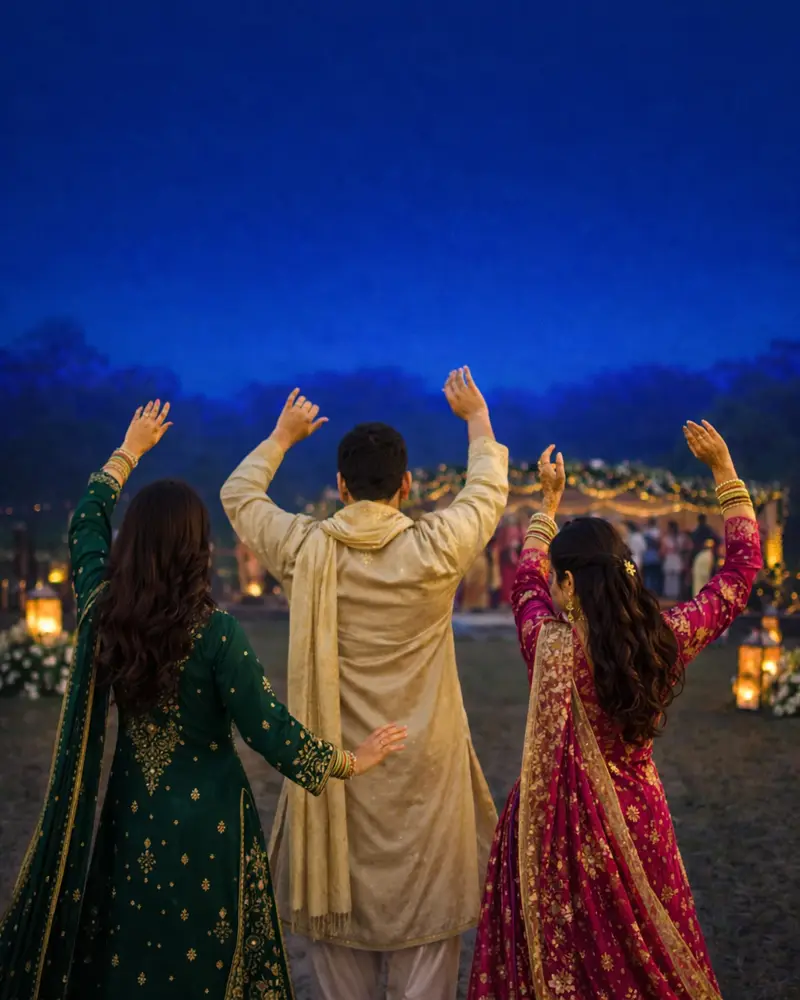
The Mehndi is the most colourful ceremony in a Saraiki wedding, held a day or two before the Nikah — a grand celebration of music, dance, and henna artistry. Both families host their own Mehndi events, though modern celebrations sometimes combine them.
The bride is seated on a stage adorned with marigolds and jasmine. A decorated thaal (platter) bearing henna, candles, and rose petals is carried in by the groom's family, and the bride's hands and feet are adorned with intricate patterns. The groom also receives henna on his palms.
What sets the Saraiki Mehndi apart is the Jhoomer — the traditional folk dance of the Saraiki people. Originating from Multan and Southern Punjab, the Jhoomer is a slow, swaying group dance performed in a circle to the dhol's beat. The word comes from 'jhoom' meaning to sway, and the dance captures the joyful spirit of Saraiki culture. Men and women perform it with graceful movements echoing the region's agricultural life.
The evening brims with dance-offs, singing competitions, and playful rivalry between the two sides. Saraiki folk songs — rich with the poetic heritage of the land of saints — provide the soundtrack.
Why it matters
Mehndi symbolizes beauty, love, and the sweetness of married life. In Saraiki tradition, the depth of the henna's colour is believed to represent the depth of the couple's love. The Jhoomer dance connects the celebration to the ancient folk traditions of Southern Punjab, making the Mehndi a living expression of Saraiki cultural identity.
In LaddoThis: a Mehndi checklist with 11 tasks, 5 of them things to buy or prepare.
Nikah نکاح
Wedding Ceremony & Feast
The sacred Islamic marriage contract ceremony
The Nikah is the spiritual and legal heart of the Saraiki wedding — the Islamic marriage ceremony that makes the union official before God, the law, and the community. In the Saraiki belt, the Nikah carries particular solemnity influenced by Multan's Sufi heritage and its reverence as the city of saints.
The ceremony is conducted at a mosque or at the bride's home. The Molvi (Islamic cleric) recites Quranic verses and the marriage sermon (Khutbah). Each side requires two witnesses. The Mehr — the obligatory dower pledged by the groom — is formally announced and documented.
The bride's consent is sought independently by the Molvi, who visits her in a separate room. She affirms her acceptance, and the Nikah Nama (marriage contract) is signed by both parties and witnesses. The Molvi then leads the gathering in dua (supplication) for blessings upon the marriage.
The Nikah is followed by distribution of dates, sharbat, and Zamzam water. Its simplicity reflects the Sufi values of devotion, humility, and love central to Saraiki culture. Families often invoke the blessings of Multan's saints — Baha-ud-din Zakariya and Shah Rukn-e-Alam — during the prayers.
--- Joota Chupai (جوتا چھپائی) ---
When the groom removes his shoes before sitting for the Nikah, the bride's sisters and cousins steal and hide them. After the ceremony, when it is time to leave, the groom discovers his shoes are missing. The bride's sisters demand a cash ransom — playful negotiations follow before the shoes are returned with much laughter.
Why it matters
The Nikah is both a sacred religious act and a legal contract. The bride's independent consent is fundamental in Islam, ensuring the marriage is entered freely. The Mehr protects the bride's financial rights. In the Saraiki context, the Nikah's connection to Sufi spirituality elevates it beyond a legal formality into a profound spiritual covenant.
Joota Chupai breaks the ice between the groom and his new in-laws — a playful tradition that builds a warm bond between the groom and the bride's sisters.
In LaddoThis: a Nikah checklist with 11 tasks, 5 of them things to buy or prepare.
Sehra Bandi سہرا بندی
Wedding Morning
Tying the floral veil on the groom before the procession
Sehra Bandi is the groom's preparation ceremony held on the wedding morning at his family home. The groom dresses in his finest attire — a sherwani or achkan paired with a pagri (turban) and Multani Khussa (the embroidered leather footwear Multan is famous for). Surma (kohl) is applied to his eyes as both a beautifying tradition and protection against the evil eye.
The centrepiece is the tying of the Sehra — a decorative floral veil of jasmine, roses, and marigold strings — placed on the groom's turban by his father or eldest brother. As the Sehra is tied, the family sings the traditional Sehra song, offering blessings and well-wishes. Guests come forward to embrace the groom and present salami (cash gifts).
The atmosphere is festive and emotional — the groom's mother and sisters often shed tears of joy seeing him transformed for his wedding day. Dhol players provide a rhythmic soundtrack as the energy builds for the Barat procession.
In Saraiki tradition, Sehra Bandi carries a particular poetic quality. The Sehra songs in Saraiki are known for their lyrical beauty, drawing on the rich literary and Sufi traditions of Southern Punjab.
Why it matters
Sehra Bandi marks the groom's formal transformation from a bachelor to a married man. The floral veil symbolizes the groom's modesty and the sacred nature of the occasion. The father or eldest brother tying the Sehra represents the family's blessings and the passing of responsibility.
In LaddoThis: a Sehra Bandi checklist with 10 tasks, 8 of them things to buy or prepare.
Barat بارات
Wedding Morning
The groom's wedding procession to the bride's venue
The Barat is the groom's grand wedding procession — one of the most spectacular moments of a Saraiki wedding. After Sehra Bandi, the groom departs from his family home accompanied by relatives, friends, and the thunderous beats of the dhol.
The procession arrives at the bride's venue with great fanfare — drums beating, fireworks lighting up the sky, and guests dancing with joy. The Barat is welcomed with warmth and playful mischief.
Once welcomed, the groom is garlanded and escorted to the stage. A grand feast is laid out — in the Saraiki belt, this is a point of immense pride for the bride's family. Signature dishes include biryani, whole roasted sajji, naan from clay tandoors, and desserts crowned by Sohan Halwa. The quality of the Barat feast is remembered in the community for years.
The Barat culminates with the groom seated on the wedding stage awaiting his bride. The couple is formally presented together for the first time, marking the beginning of their union before the assembled guests.
Why it matters
The Barat is a public declaration of the marriage, bringing the groom to the bride's doorstep with full community witness. In Saraiki culture, the grandeur of the procession and the quality of the feast are expressions of family honour and hospitality — core values in the social fabric of Southern Punjab.
In LaddoThis: a Barat checklist with 8 tasks, 2 of them things to buy or prepare.
Rukhsati رخصتی
Wedding Ceremony & Feast
The bride's emotional farewell and departure
Rukhsati is the most emotionally charged moment of a Saraiki wedding — the bride's departure from her parents' home. No ceremony captures the bittersweet nature of a wedding as powerfully as the Rukhsati.
As celebrations draw to a close, the bride prepares to leave. The Quran is held above her head as she walks to the decorated car, symbolizing divine protection for her new journey. Her father, brothers, and close male relatives walk beside her while her mother and female relatives gather at the doorstep, many weeping openly.
In Saraiki tradition, this moment is accompanied by deeply moving folk songs of farewell sung by the women. These songs — in the melodic Saraiki language — express a mother's love, a father's pride, and the poignant reality of a daughter leaving home. The poetry of these farewell songs is among the most beautiful in the Saraiki folk repertoire.
The bride embraces each family member, and the groom leads her gently to the car. As they drive away, the family watches until the car disappears — a silent, deeply personal moment. Rice and flower petals are thrown over the departing car as a final blessing.
Why it matters
Rukhsati marks the bride's transition from her natal home to her new life. The Quran held over her head represents God's protection on this journey. The communal tears are not of sadness alone but of the profound love between a family and their daughter. In Saraiki culture, the farewell songs elevate this moment into living poetry.
In LaddoThis: a Rukhsati checklist with 8 tasks, 4 of them things to buy or prepare.
Walima ولیمہ
Post-Wedding
The groom's grand reception feast for the community
The Walima is the grand reception feast hosted by the groom's family, typically held one to three days after the Nikah. It is a religious Sunnah — a practice of the Prophet Muhammad (PBUH) — and is considered an essential part of the Islamic wedding in Saraiki tradition.
The newlywed couple is seated on an elegantly decorated stage as guests arrive to offer congratulations, blessings, and gifts. The atmosphere is celebratory and proud — this is the groom's family's moment to publicly present the couple and demonstrate their hospitality to the community.
The feast is the centrepiece of the Walima. In the Saraiki belt, the menu reflects the rich culinary traditions of Southern Punjab — aromatic biryani, sizzling karahi, freshly baked naan from clay tandoors, and an abundance of desserts. Sohan Halwa — the crown jewel of Multani confectionery — is always present, along with kheer, gulab jamun, and seasonal fruits.
The Walima also serves as the bride's formal introduction to the groom's extended social and professional circles. In Saraiki communities, the generosity and quality of the Walima feast is a matter of family pride, discussed in the community long after.
Why it matters
The Walima fulfils a religious Sunnah and a social responsibility. It publicly announces the marriage, introduces the bride to the groom's community, and expresses gratitude to all who supported the wedding. In Saraiki tradition, the warmth of the hospitality reflects the family's values and standing in the community.
In LaddoThis: a Walima checklist with 9 tasks, 4 of them things to buy or prepare.
Khoula کھولا
Post-Wedding
The bride's first return visit to her parents' home
Khoula is the bride's first return visit to her parents' home after the wedding — a tradition deeply cherished in Saraiki culture. Typically held a few days after the Walima, the couple travels together to the bride's natal home, where they are received with great warmth and celebration.
The bride's mother prepares a special feast, and the home is filled with excitement at welcoming back their daughter — now a married woman with her husband. The groom brings gifts and sweets for the bride's family as a gesture of respect and gratitude.
In the Saraiki belt, Khoula is more than a social visit — it affirms that bonds between the bride and her natal family remain strong after marriage. The couple typically stays for a night or more, and the bride spends time with her parents, siblings, and childhood friends in familiar surroundings.
The visit concludes with the bride's parents sending the couple back with gifts, blessings, and often home-cooked food for the groom's family. Khoula marks the completion of the wedding cycle — the daughter has gone and returned, and both families are now joined forever.
Why it matters
Khoula reassures the bride and her family that marriage does not sever the bond with her natal home. It establishes a rhythm of visiting and connection that will continue throughout the marriage. In Saraiki culture, where family bonds are paramount, Khoula is a vital tradition that honours the bride's roots.
In LaddoThis: a Khoula checklist with 6 tasks, 3 of them things to buy or prepare.
Jhoomer Night جھومر نائٹ
2-3 Days Before
Traditional Saraiki folk dance and music celebration
Jhoomer Night is a vibrant celebration of Saraiki folk culture held as part of the wedding festivities — often combined with the Mehndi or as a standalone event. The Jhoomer is the traditional folk dance of the Saraiki people from Multan and Southern Punjab, and the most distinctive cultural expression in a Saraiki wedding.
The dance is performed in a circle, with men and women swaying rhythmically to the dhol's beat. 'Jhoomer' derives from 'jhoom' — to sway — capturing gentle, flowing movements inspired by the agricultural rhythms of the Indus plains. Dancers evoke the gaits of animals, sowing seeds, and harvesting crops through graceful, stylized movements.
Musical accompaniment features the dhol, tumbi (single-stringed instrument), and soulful Saraiki singing. The songs carry themes of love, longing, and the beauty of Southern Punjab, with many reflecting the influence of Multan's Sufi poets and saints.
A Qawwali session is often included, connecting the celebration to the region's Sufi heritage. Jhoomer dancing and Qawwali together create an atmosphere uniquely Saraiki — joyful yet spiritually grounded, celebratory yet rooted in tradition.
Why it matters
The Jhoomer is more than a dance — it is the living expression of Saraiki identity. Performing it at weddings connects the celebration to the ancient folk traditions of Southern Punjab and the Sufi spirituality of Multan. The Jhoomer Night ensures that each new generation experiences and carries forward this distinctive cultural heritage.
In LaddoThis: a Jhoomer Night checklist with 8 tasks, 1 of them things to buy or prepare.