 LaddoThis
Sindhi Muslim wedding ceremonies, in order
A Sindhi Muslim wedding usually moves through 13 ceremonies: Gaalh Paki, Mangni, Mayoun, Mehndi, Sehra Bandi, Nikah, Pani ji Rasm & Surmo, Doodh Pilai, Rukhsati, Walima, Satawara, Sindhi Topi & Ajrak Ceremony and Dua-e-Khair. Below is each one in order, when it usually happens and what it means. Customs vary between families and regions, so treat this as the common sequence, not a rule.
13 ceremonies112 checklist tasks in the app
At a glance
- 6+ Months BeforeGaalh Paki ڳالھ پڪيThe formal marriage proposal and acceptance
- 3-4 Months BeforeMangni منگڻيThe formal engagement ceremony with ring exchange
- 3-5 Days BeforeMayoun مائونThe turmeric purification ceremony and bride's seclusion
- Mehndi مهنديThe vibrant henna ceremony with Sindhi music and dance
- Nikah DaySehra Bandi سهرا بنديThe groom is dressed with Sindhi Topi and the baraat begins
- Nikah نکاحThe sacred Islamic marriage contract ceremony
- Pani ji Rasm & Surmo پاڻي جي رسمWater sprinkling and kohl rituals welcoming the groom
- Doodh Pilai دُودھ پلائيThe groom is offered milk and must pay a ransom
- Rukhsati رخصتيThe emotional farewell as the bride departs her parental home
- After NikahWalima وليموThe grand wedding feast hosted by the groom's family
- Post-WeddingSatawara ستاواروThe bride's first return to her parents' home after the wedding
- Sindhi Topi & Ajrak Ceremony سنڌي ٽوپي ۽ اجرڪHonouring Sindhi heritage through traditional dress and fabric
- 3-5 Days BeforeDua-e-Khair دعائے خيرA prayer gathering seeking blessings for the couple
Gaalh Paki ڳالھ پڪي
6+ Months Before
The formal marriage proposal and acceptance
Gaalh Paki is the very first step in a Sindhi Muslim wedding. The groom's family visits the bride's home in a meeting called padhri, where they formally ask the bride's parents for permission for their son to marry their daughter.
If the bride's parents — with the bride's consent — accept the proposal, sweets and milk are served to the visiting family. This moment of acceptance is called Gaalh Paki, which literally means 'the word is sealed.' Elders from both families offer prayers and duas for the couple's future happiness.
The atmosphere is warm and intimate, typically involving only the closest family members. Once Gaalh Paki is complete, the families consider the match settled and begin preparations for the Mangni (formal engagement).
Why it matters
Gaalh Paki reflects the Sindhi Muslim emphasis on family consent and mutual respect. The word 'paki' means firm or settled — once the word is given, it carries deep honour. This ceremony ensures that both families and the bride herself have given informed, willing consent before proceeding, which aligns with the Islamic principle that marriage requires the bride's free agreement.
In LaddoThis: a Gaalh Paki checklist with 5 tasks, 2 of them things to buy or prepare.
Mangni منگڻي
3-4 Months Before
The formal engagement ceremony with ring exchange
Mangni (also called Manghni or Manghno in Sindhi) is the formal engagement ceremony that publicly announces the match. Close friends and relatives from both families gather to witness the commitment.
The ceremony begins with a recitation from the Holy Quran and a dua for blessings. The bride and groom exchange rings — in traditional Sindhi Muslim families, this may be done through female intermediaries. Both families exchange beautifully decorated trays filled with sweets, dry fruits, clothes, and gifts.
The groom's family presents the bride with clothing and jewelry, while the bride's family reciprocates with an outfit for the groom. Elders bless the couple and give salami (cash gifts in envelopes). Sweets are distributed widely to the community to formally announce the engagement.
In Sindhi tradition, the Mangni is ideally performed on auspicious days — Monday, Wednesday, Thursday, or Friday — during the months of Ramazan, Rabi el Akhar, Rajab, or Shaaban.
Why it matters
Mangni marks the public declaration of intent to marry. After this ceremony, both families consider the match irrevocably settled and begin full wedding preparations. It strengthens the bond between the two families and allows the wider community to share in the joy. In Sindhi culture, breaking an engagement after Mangni carries deep social consequences.
In LaddoThis: a Mangni checklist with 10 tasks, 6 of them things to buy or prepare.
Mayoun مائون
3-5 Days Before
The turmeric purification ceremony and bride's seclusion
Mayoun (also called Ubtan in Sindhi Muslim families) is a pre-wedding purification ceremony held a day or two before the Nikah. Both families perform it separately at their own homes.
The bride or groom is seated on a decorated chowki (low stool) while a red cloth is held above by four married female relatives. A paste of turmeric, sandalwood powder, rose water, flour, and mustard oil is prepared. The bride's or groom's mother applies the paste first, followed by aunts, married women of the biradari (clan), cousins, and friends. Each woman takes her turn, smearing the ubtan on the face, arms, and legs.
Women sing traditional Sindhi folk songs to the beat of a dholak while the ubtan is applied. After the ceremony, the bride enters a period of seclusion (mayoun) — she is not permitted outdoor activities and is asked to relax at home, away from household chores and the sun, until the wedding day. The ubtan is washed off with rose water, leaving the skin glowing.
In Sindhi tradition, the Mayoun period is taken seriously — the bride should rest and be pampered before her big day.
Why it matters
The turmeric paste is believed to purify the body and soul, ward off the evil eye (nazar), and give the skin a natural bridal glow. The seclusion after Mayoun symbolizes a period of sanctity and transformation before the Nikah. The bride is preparing herself — physically and spiritually — for her new life. The communal application of ubtan by married women is believed to transfer their blessings of successful marriages to the bride.
In LaddoThis: a Mayoun checklist with 9 tasks, 8 of them things to buy or prepare.
Mehndi مهندي
3-5 Days Before
The vibrant henna ceremony with Sindhi music and dance
The Mehndi ceremony (called Sagri in Sindhi tradition) is one of the most colourful and joyful pre-wedding celebrations in a Sindhi Muslim wedding. Held one to two days before the Nikah, it is a festive gathering where intricate henna designs are applied to the bride's hands, arms, and feet.
The bride sits in a decorated area — traditionally surrounded by cushions, Ajrak-draped fabrics, flowers, and colourful lanterns — while a professional artist applies elaborate designs that can take three to five hours. The groom's initials or name are often hidden within the patterns for him to find later. Female relatives and friends also get henna applied.
For the Sagri, the groom's family visits the bride's family to formally acquaint themselves. They bring sweets and gifts for the bride. The celebration is filled with Sindhi folk music, dancing, and traditional songs sung to the beat of the dhol and dholak. Modern Mehndi functions in Sindhi families feature choreographed dance performances and DJ music alongside the traditional elements.
Why it matters
Mehndi is considered a sunnah and is believed to bring barakat (blessings) to the marriage. The Sagri aspect represents the formal bonding between the two families. It is believed that the darker the henna stains, the stronger the love between husband and wife. In Sindhi culture, the Mehndi night is a women-centric celebration that honours female joy, creativity, and community.
In LaddoThis: a Mehndi checklist with 11 tasks, 4 of them things to buy or prepare.
Sehra Bandi سهرا بندي
Nikah Day
The groom is dressed with Sindhi Topi and the baraat begins
Sehra Bandi is the ceremony of preparing the groom for his wedding day, held at the groom's home before the jjanjja (baraat) departs for the Nikah venue.
The groom is dressed in his finest sherwani or achkan. A Sindhi Topi — the traditional embroidered cap symbolising Sindhi dignity — is placed on his head (mandatory for a Sindhi groom, just as the bride must wear her Nath). An Ajrak shawl in deep crimson and indigo is draped over his shoulders.
The sehra — a veil of flowers (jasmine or mogra) or strings of pearls — is tied to the front of the topi, draping over his face. Surma (kohl) is applied to his eyes by his sister or sister-in-law. A commissioned poem praising the groom is recited or sung.
Parents and elders bless the groom, feed him sweets, and give shagun (monetary blessings), with shehnai and dhol music playing.
The groom then departs in a decorated car or on horseback, accompanied by family and friends dancing to dhol beats. The jjanjja makes its way to the Nikah venue with great pomp and celebration.
Why it matters
The Sindhi Topi symbolizes dignity, leadership, and cultural heritage — wearing it at the wedding connects the groom to generations of Sindhi tradition. The Ajrak represents the ancient Indus civilization heritage of Sindh, traceable to Moenjodaro. The floral sehra symbolizes prosperity and joy. In Sindhi Muslim culture, the Sehra Bandi transforms the groom from an ordinary man into a bridegroom worthy of his bride.
In LaddoThis: a Sehra Bandi checklist with 11 tasks, 8 of them things to buy or prepare.
Nikah نکاح
Nikah Day
The sacred Islamic marriage contract ceremony
The Nikah is the heart of a Sindhi Muslim wedding — the solemn Islamic marriage contract officiated by a Qazi or Maulvi following the Shariah framework of Ijab (proposal) and Qubool (acceptance).
The ceremony begins with a Khutba-e-Nikah — a sermon with Quranic verses and Hadith about the sanctity of marriage. The Mahr (dower), an obligatory gift from the groom that is the bride's exclusive right, is formally announced.
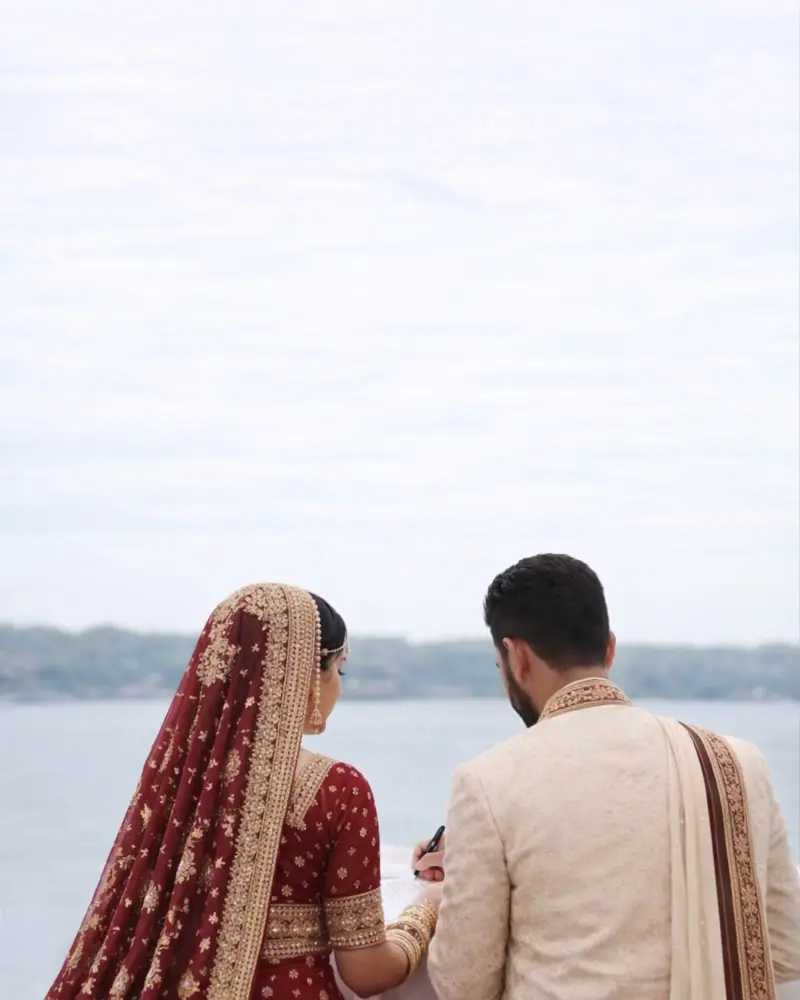
The Qazi asks the groom three times: 'Do you accept this marriage?' He responds 'Qubool hai' three times. The same is asked of the bride. Two adult male Muslim witnesses must be present, and the Nikah-Nama (marriage contract) is signed by the bride, groom, witnesses, and the Qazi.
After the Nikah, unique Sindhi rituals take place at the bride's home entrance. In Dhakkun Bhanjan, the groom must stomp and break a small earthen pot-cover (dhakkanu) in one attempt. In Kandi Kapanu, a thorn branch is planted and the groom cuts through it with a sword. In Daawan Diyan, the bride's sister ties a thread between the groom's finger and foot, which he must break. These playful tests are accompanied by demands for cash from the bride's sisters.
Why it matters
In Islam, the Nikah is a sacred contract (aqd) that establishes mutual rights and responsibilities between husband and wife. The Mahr protects the bride's financial independence. The Qubool must be given freely — consent is the cornerstone of Islamic marriage. The Sindhi entrance rituals (Dhakkun Bhanjan, Kandi Kapanu) add a uniquely Sindhi cultural layer, testing the groom's mettle and creating joyful bonding between the families.
In LaddoThis: a Nikah checklist with 18 tasks, 9 of them things to buy or prepare.
Pani ji Rasm & Surmo پاڻي جي رسم
Nikah Day
Water sprinkling and kohl rituals welcoming the groom
Pani ji Rasm and Surmo are a series of playful post-Nikah rituals performed by the bride's sisters, cousins, and female friends when the groom enters the bride's home after the Nikah ceremony.
In Pani ji Rasm, drops of water or rose water are sprinkled on the groom as a gesture of purification and welcome. The bride's sisters then apply surmo (kohl/kajal) to the groom's eyes — a ritual believed to protect him from the evil eye and enhance his appearance for the bride.
In the Daawan Diyan ceremony, the bride's sister ties a long thread between the groom's little finger and his foot. The groom must break or tear the thread by pulling it in opposite directions — a light-hearted test of his dexterity.
Throughout these rituals, the bride's sisters and friends demand money from the groom in exchange for completing each ceremony. The negotiations are playful and filled with laughter, creating a warm bonding moment between the groom and his new extended family.
Why it matters
These rituals symbolize the bride's family's playful acceptance of the groom into their fold. The water purifies, the surmo protects from evil eye, and the thread ceremony tests the groom's patience and good humour. The exchange of cash represents the groom's willingness to be generous with his new family. These are uniquely Sindhi traditions that distinguish Sindhi Muslim weddings from other communities.
In LaddoThis: a Pani ji Rasm & Surmo checklist with 6 tasks, 5 of them things to buy or prepare.
Doodh Pilai دُودھ پلائي
Nikah Day
The groom is offered milk and must pay a ransom
Doodh Pilai is a beloved and playful ceremony that takes place after the Nikah, typically when the groom is about to take the bride home. The bride's younger sister (or a close female cousin) presents the groom with a beautifully decorated glass of milk.
The groom must drink the milk — but first, he must pay for it. The bride's sister demands a ransom, and hilarious negotiations ensue between the groom's side and the bride's sisters. The amount can range from modest to extravagant, depending on the family's tradition and the groom's generosity. Once the groom pays up and drinks the milk, he offers the glass to the bride to sip as well.
The ceremony is filled with teasing, laughter, and good-natured bargaining. It is one of the most anticipated moments of the wedding, especially for the younger members of the bride's family.
Why it matters
Doodh Pilai symbolizes the groom's acceptance into the bride's family and his willingness to be generous. Milk represents purity, nourishment, and the sweetness of the new relationship. The ransom tradition ensures the bride's younger siblings feel included and valued in the wedding. It also establishes a warm, playful bond between the groom and his new in-laws.
In LaddoThis: a Doodh Pilai checklist with 4 tasks, 3 of them things to buy or prepare.
Rukhsati رخصتي
Nikah Day
The emotional farewell as the bride departs her parental home
Rukhsati is the most emotionally charged moment of a Sindhi Muslim wedding. It is the formal farewell of the bride as she leaves her parental home to begin her new life with her husband.
After all the rituals and the feast, the bride prepares to depart. She embraces her parents, siblings, grandparents, and family members one by one in an emotional goodbye. Tears flow freely as the reality of the departure sinks in. The bride's father or elder brother recites a dua for her protection and happiness.
As the bride steps out, the Holy Quran is held above her head — a gesture of divine protection as she transitions to her new home. In the Sindhi tradition of Chawar ji Rasam, the bride takes rice in her hands and throws it behind her as she leaves — symbolizing prosperity and gratitude to her parental home.
The bride is guided to the decorated car by her brothers or close male relatives. Family members and friends shower prayers and blessings as the car departs.
Why it matters
Rukhsati marks the beginning of the bride's new chapter. The Quran held over her head symbolizes that she leaves under the protection of Allah. Chawar ji Rasam — the throwing of rice — is a uniquely Sindhi tradition symbolizing that the bride wishes prosperity upon her birth family even as she departs. The farewell is bittersweet — joyful because she is married, sorrowful because she is leaving home.
In LaddoThis: a Rukhsati checklist with 9 tasks, 7 of them things to buy or prepare.
Walima وليمو
After Nikah
The grand wedding feast hosted by the groom's family
Walima (called Gadjani in traditional Sindhi) is the grand wedding reception and feast hosted by the groom's family, typically held the day after the Nikah or within a few days. It is a sunnah of the Prophet Muhammad (peace be upon him) and is an essential part of the celebrations.
The couple makes a grand entrance and is seated on a beautifully decorated stage, often featuring Ajrak-inspired decor and fresh flowers. Guests line up to congratulate the newlyweds, offer blessings (duas), and present gifts — typically cash in envelopes (salami). During the Gadjani, the bride is informally introduced to the extended members of the groom's family.
A lavish dinner is served featuring Sindhi cuisine at its finest: Sindhi Biryani (spicier and tangier than other regional varieties, with potatoes and distinctive masala), Sajji (whole roasted lamb or chicken — a Sindhi/Balochi specialty), kebabs, Sindhi Kadhi, and an array of desserts including Sohan Halwa (the famous Sindhi confection from Hyderabad, Sindh), Gulab Jamun, and Phirni.
The evening features music — often Sindhi folk songs alongside modern DJ sets — singing, and dancing.
Why it matters
The Walima is a sunnah — the Prophet Muhammad (peace be upon him) emphasized that the feast should be inclusive, inviting both rich and poor. It publicly announces the marriage to the wider community and is the groom's family's way of honouring their new daughter-in-law. In Sindhi culture, the Gadjani is the celebration where the bride is formally welcomed into the groom's extended clan and community.
In LaddoThis: a Walima checklist with 11 tasks, 4 of them things to buy or prepare.
Satawara ستاوارو
Post-Wedding
The bride's first return to her parents' home after the wedding
Satawara is the post-wedding ceremony in which the bride returns to her parents' home for the first time after the wedding, accompanied by her husband. A date is determined — traditionally by a religious elder or elder family member — and the couple visits the bride's family for a special lunch or dinner.
The bride's family welcomes the couple warmly. This is an emotional reunion — the bride left in tears during the Rukhsati and now returns as a married woman. A lavish meal is prepared, featuring the groom's favourite dishes as a way of honouring the son-in-law. The bride's parents present gifts to the couple — new clothes, jewellery, cash, sweets, and dry fruits.
The couple typically spends several hours at the bride's parents' home. The atmosphere is relaxed, intimate, and filled with affection. It gives the bride comfort that she remains deeply connected to her birth family, and the groom an opportunity to strengthen bonds with his in-laws.
Why it matters
Satawara reassures the bride that she remains deeply loved by her birth family despite having moved to a new home. It gives the bride's parents the comfort of seeing their daughter happy and settled. For the groom, it is a gesture of respect and an opportunity to build a warm relationship with his new in-laws. This visit formally concludes all the wedding rituals in Sindhi Muslim tradition.
In LaddoThis: a Satawara checklist with 7 tasks, 5 of them things to buy or prepare.
Sindhi Topi & Ajrak Ceremony سنڌي ٽوپي ۽ اجرڪ
Honouring Sindhi heritage through traditional dress and fabric
The Sindhi Topi and Ajrak are not a standalone ceremony but cultural elements woven throughout the Sindhi Muslim wedding. Many families hold a special moment — often during the Mehndi or Walima — to honour and present these items.
The Sindhi Topi is a richly embroidered cap and cornerstone of Sindhi male identity. Historically, appearing bare-headed in Sindh was considered disrespectful. For the groom, wearing it is mandatory, connecting him to centuries of Sindhi tradition.
The Ajrak is a block-printed cloth with crimson red and indigo blue backgrounds, bearing symmetrical patterns with white star motifs. Its origins trace to the Indus Valley civilization of Moenjodaro (around 4000 BCE), making it one of the oldest living textile traditions in the world. In Sindhi culture, Ajrak is used from cradle to grave — as a hammock, headgear, bridal accessory, turban, shawl, and gift of honour.
At the wedding, Ajrak shawls are draped over the groom, presented to honoured guests, and used in stage decoration. The bride wears a Gandi scarf — a richly embroidered head covering that is the female counterpart to the groom's Topi.
Why it matters
The Sindhi Topi and Ajrak represent the soul of Sindhi identity. Wearing them at a wedding is a declaration of cultural pride and continuity. The Ajrak's ancient origins connect the wedding to the Indus civilization — one of the oldest in human history. Gifting Ajrak to guests is a mark of the highest respect and honour in Sindhi culture, continuing a tradition that Muslim Sindhi rulers practised for centuries.
In LaddoThis: a Sindhi Topi & Ajrak Ceremony checklist with 6 tasks, 4 of them things to buy or prepare.
Dua-e-Khair دعائے خير
3-5 Days Before
A prayer gathering seeking blessings for the couple
Dua-e-Khair is a prayer gathering held before the wedding — often on the morning of the Nikah day or a day or two before. Family elders and a Maulvi gather to recite specific surahs from the Holy Quran and make collective dua (supplication) for the couple's happiness, prosperity, and a blessed married life.
The gathering is typically intimate and solemn. Verses from the Quran are recited, followed by heartfelt prayers for the couple and both families. Dates and sweets are distributed as tabarruk (blessed food) at the conclusion.
In Sindhi Muslim families, this gathering holds special importance as it anchors the wedding celebrations in faith before the festivities begin. The bride's family and groom's family may hold separate Dua-e-Khair gatherings at their respective homes.
Why it matters
Starting the wedding journey with collective prayer anchors the celebrations in faith. It reminds both families that marriage is a sacred trust from Allah and that divine blessings are the foundation of a successful union. The communal prayer strengthens family bonds and brings spiritual peace before the excitement of the wedding day.
In LaddoThis: a Dua-e-Khair checklist with 5 tasks, 3 of them things to buy or prepare.