 LaddoThis
Muhajir (Urdu-speaking Pakistani) wedding ceremonies, in order
A Muhajir (Urdu-speaking Pakistani) wedding usually moves through 11 ceremonies: Mangni, Dholki, Mayoun, Mehndi, Nikah, Sehra Bandi & Barat, Arsi Mushaf, Rukhsati, Walima, Chauthi and Doodh Pilai. Below is each one in order, when it usually happens and what it means. Customs vary between families and regions, so treat this as the common sequence, not a rule.
11 ceremonies112 checklist tasks in the app
At a glance
- 6+ Months BeforeMangni منگنیThe formal engagement ceremony with ring exchange and gift trays
- 5-10 Days BeforeDholki ڈھولکیTraditional singing nights leading up to the wedding with folk songs and Dholki drum
- 2-4 Days BeforeMayoun مایوںThe turmeric purification ceremony and bride's seclusion period
- Mehndi مہندیThe vibrant henna ceremony with music, dance, and elaborate stage
- Wedding DayNikah نکاحThe sacred Islamic marriage contract solemnized by the Qazi
- Sehra Bandi & Barat سہرا بندی اور باراتThe groom is adorned with Sehra and the wedding procession departs
- Arsi Mushaf آرسی مصحفThe mirror-and-Quran ceremony where the couple sees each other for the first time
- Rukhsati رخصتیThe emotional farewell as the bride departs her parental home
- After WeddingWalima ولیمہThe grand wedding feast hosted by the groom's family
- Chauthi چوتھیThe bride's first return to her parents' home on the fourth day after the wedding
- Wedding DayDoodh Pilai دودھ پلائیThe milk ceremony where the bride's sister demands a playful ransom
Mangni منگنی
6+ Months Before
The formal engagement ceremony with ring exchange and gift trays
Mangni is the formal engagement ceremony that publicly announces the match between two families. It is a joyful occasion rooted in Muhajir tradition, blending customs of Lucknow, Hyderabad Deccan, and the UP-Bihar belt from which the community traces its ancestry.
The ceremony takes place at the bride's home or a banquet hall. It opens with a Quran recitation and dua for blessings. Rings are exchanged — in traditional families, through female intermediaries. Both families bring decorated trays (in odd numbers: 5, 7, or 9) filled with sweets, dry fruits, clothing, and gifts.
The groom's family presents the bride with an outfit, jewelry, and perfume, while the bride's family reciprocates with an outfit for the groom. Elders bless the couple and give Salami (cash gifts in envelopes). Mithai — especially ladoo — is distributed to the community to announce the engagement.
In Muhajir culture, the Mangni carries deep social weight. Once performed, the match is considered settled and wedding preparations begin in earnest.
Why it matters
Mangni represents the public declaration of intent to marry and the formal bonding of two families. In the Muhajir community, where extended family networks and biradari (clan) ties remain strong, the engagement serves as a social contract witnessed by elders and community members. The exchange of rings and gifts symbolizes mutual commitment and respect between the families.
In LaddoThis: a Mangni checklist with 11 tasks, 8 of them things to buy or prepare.
Dholki ڈھولکی
5-10 Days Before
Traditional singing nights leading up to the wedding with folk songs and Dholki drum
The Dholki is one of the most beloved features of a Muhajir wedding — a series of intimate musical gatherings held over several evenings (typically three to five) before the Mehndi and Barat. Named after the small two-headed drum that provides the rhythmic heartbeat, these gatherings are deeply rooted in the community's Urdu-speaking culture.
Traditionally a women-only affair, relatives, friends, and neighbours gather at the bride's home on floor cushions and daris (mats), singing Urdu and Punjabi wedding songs. The songs — Suhaag, Ghorian, Ratti — celebrate the bride's beauty, the groom's arrival, tease the in-laws, and capture the bittersweet emotions of the bride leaving home.
The evenings carry a distinct Lucknowi and Hyderabadi flavour. Elders who remember songs from pre-Partition days lead the singing, passing down melodies spanning generations. The atmosphere is festive yet intimate — chai, samosas, pakoras, and chaat are served as singing continues late into the night.
In modern Muhajir families, the Dholki includes both men and women, with some hiring professional players. The essence remains — communal singing, laughter, and building excitement for the wedding.
Why it matters
The Dholki is the cultural heartbeat of a Muhajir wedding. It connects the community to its roots in UP, Bihar, and Hyderabad Deccan, preserving songs and melodies that migrated with families during Partition in 1947. These gatherings strengthen family bonds, bridge generational gaps, and build the emotional crescendo leading to the wedding day. For many Muhajir families, the Dholki nights are the most cherished memories of the entire wedding celebration.
In LaddoThis: a Dholki checklist with 10 tasks, 4 of them things to buy or prepare.
Mayoun مایوں
2-4 Days Before
The turmeric purification ceremony and bride's seclusion period
Mayoun (also called Ubtan) is a pre-wedding purification ceremony held one to two days before the Nikah or Barat. Both families perform it separately, though the bride's ceremony is more elaborate.
The bride is seated on a decorated chowki (low stool) while married female relatives hold a yellow dupatta above her head. A paste of turmeric, sandalwood, rose water, gram flour, and mustard oil — called ubtan — is prepared. The bride's mother applies it first, followed by aunts, married women of the biradari, and friends. A thick thread called a Gana is tied on the bride's wrist, marking the start of her seclusion.
Women sing traditional Mayoun songs to the beat of a Dholak, celebrating the bride and teasing her about her groom. Afterwards, the bride enters seclusion — she stays home, avoids the sun, and is pampered until the wedding day. The ubtan is believed to give a natural bridal glow.
In Muhajir families with Hyderabad Deccan roots, the Mayoun includes a special ubtan tray called suhaag pura from the groom's family, containing the yellow outfit, bangles, henna, cosmetics, and ubtan ingredients — demonstrating care for their future daughter-in-law.
Why it matters
The ubtan purification symbolizes the preparation of the bride — physically and spiritually — for her new life. The turmeric is believed to ward off the evil eye (nazar) and bestow blessings. The seclusion period allows the bride to rest and reflect before the life-changing events ahead. The communal application of ubtan by married women is believed to transfer their blessings of happy marriages to the bride. The yellow colour of the ceremony represents joy, prosperity, and auspiciousness.
In LaddoThis: a Mayoun checklist with 10 tasks, 9 of them things to buy or prepare.
Mehndi مہندی
2-4 Days Before
The vibrant henna ceremony with music, dance, and elaborate stage
The Mehndi is the most colourful and eagerly anticipated event of a Muhajir wedding. Held one to two days before the Barat, it is an exuberant celebration of music, dance, henna, and feasting — often the most elaborately staged occasion.
The bride sits on a decorated stage adorned with cushions, drapes, fairy lights, and fresh flowers while a professional artist applies intricate henna designs on her hands, arms, and feet. The application takes three to five hours, with the groom's initials traditionally hidden in the patterns. The groom's family sends decorated Mehndi thaals (trays) containing henna, sweets, bangles, and gifts.
The highlight is the entertainment. Family members perform choreographed dance numbers rehearsed for weeks, set to film songs, Urdu qawwalis, and popular hits. Between performances, guests dance freely to DJ music or Dholak beats. The energy is electric.
The Mehndi also includes Rasm-e-Henna — where the bride's and groom's mothers ceremonially apply the first dab of henna to the other's child, symbolizing the families' union. Catering features kebab stations, chaat, biryani, and mithai displays.
Why it matters
Mehndi is considered a sunnah and is believed to bring barakat (blessings) to the marriage. In Muhajir culture, the Mehndi night represents the peak of pre-wedding joy. The henna symbolizes love, beauty, and good fortune — the darker the stain, the stronger the bond between husband and wife. The elaborate stage and choreographed performances reflect the Muhajir community's deep appreciation for art, music, and celebration — values inherited from the refined cultures of Lucknow and Hyderabad.
In LaddoThis: a Mehndi checklist with 14 tasks, 7 of them things to buy or prepare.
Nikah نکاح
Wedding Day
The sacred Islamic marriage contract solemnized by the Qazi
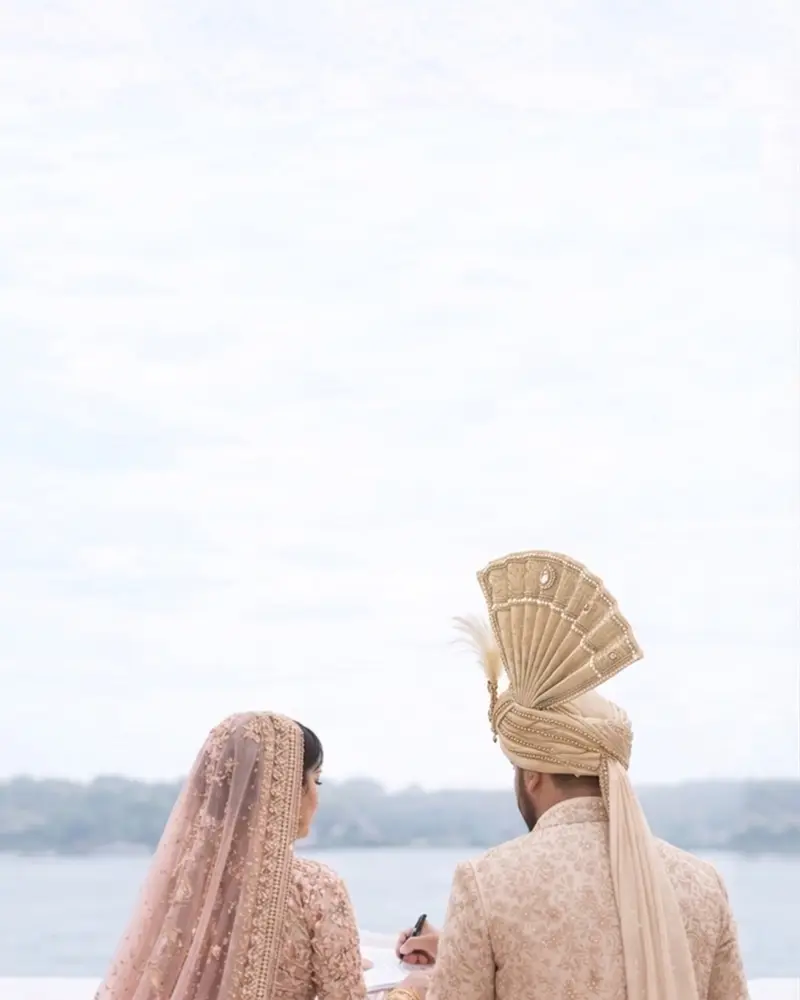
The Nikah is the religious cornerstone of a Muhajir wedding — the solemn Islamic marriage contract that binds the couple before Allah and the community. It may be performed on the same day as the Barat or separately, depending on the family's preference.
Officiated by a Maulvi or Qazi, it begins with a Khutba-e-Nikah — a sermon with verses from the Quran and Hadith on the sanctity of marriage. The Mahr (dower) — an obligatory gift from the groom that is the bride's exclusive right — is announced. The Qazi asks the groom three times: 'Qubool hai?' (Do you accept?), and the groom affirms each time. The same is asked of the bride. Two adult male Muslim witnesses must be present.
The Nikah-Nama (marriage contract) is signed by the bride, groom, witnesses, and Qazi. In traditional families, the bride may designate a Wakeel (representative) — her father, brother, or uncle — to convey her consent. Dates are then distributed as a blessed offering, and sharbat or sweetened milk is served.
Muhajir Nikahs are dignified and solemn, reflecting the community's emphasis on religious sanctity. The ceremony is usually completed within thirty to forty-five minutes.
--- Jhoota Chhupai (جوتا چھپائی) ---
When the groom removes his shoes before sitting on the wedding stage for the Nikah, the bride's sisters and cousins swiftly steal and hide them. After the ceremony, when it is time to leave, the groom discovers his shoes are missing. The bride's sisters demand a ransom — which can range from a token amount to a lavishly negotiated sum. The negotiations are playful, theatrical, and filled with laughter. The groomsmen often attempt to guard or retrieve the shoes, but the bride's team is invariably more cunning. In Muhajir families, Jhoota Chhupai is taken seriously as a tradition — the amount negotiated becomes a source of family storytelling for years to come.
Why it matters
In Islam, the Nikah is a sacred contract (aqd) that establishes mutual rights and responsibilities between husband and wife. The Mahr protects the bride's financial independence and is her absolute right. The consent (Qubool) of both parties — particularly the bride's — is essential and the Nikah is invalid without it. For Muhajir families, the Nikah connects the couple to centuries of Islamic scholarly tradition from Lucknow, Delhi, and Hyderabad, where the Nikah was performed with particular reverence and formality.
Jhoota Chhupai breaks the ice between the groom and his new in-laws, especially the younger members of the bride's family. It establishes a playful, warm bond between the groom and his wife's sisters — a relationship that carries social importance in Muhajir culture.
In LaddoThis: a Nikah checklist with 17 tasks, 8 of them things to buy or prepare.
Sehra Bandi & Barat سہرا بندی اور بارات
Wedding Day
The groom is adorned with Sehra and the wedding procession departs
Sehra Bandi is the ceremony of preparing the groom, performed at his home before the Barat departs. It is one of the most photogenic and emotionally charged moments of a Muhajir wedding.
The groom is dressed in his finest Sherwani — typically heavily embroidered zardozi work in gold, cream, or deep colours. A Kulla (turban) is placed on his head and the Sehra — a veil of fresh jasmine (mogra) or pearl strings — is tied to the front, draping over his face. Surma (kohl) is applied to his eyes by a sister, and Ittar (perfume) to his wrists. A specially commissioned poem praising the groom may be recited by a family member.
Elders bless the groom, feed him sweets, and give Salami (cash gifts). The atmosphere is emotional as the groom's mother and sisters realize he is about to begin his married life.
--- Barat ---
The Barat is the groom's wedding procession — a celebratory cavalcade of family and friends travelling to the bride's venue, accompanied by Shehnai (oboe) and Dhol (drum), the unmistakable soundtrack of a Muhajir wedding. Guests dance and celebrate in the procession. Upon arrival, the bride's family receives them with garlands, rose petals, and refreshments.
Why it matters
The Sehra Bandi transforms the groom into the Dulha — the bridegroom. The floral Sehra symbolizes freshness, joy, and new beginnings. The Barat procession with Shehnai and Dhol is a public declaration of celebration that the entire neighbourhood witnesses. In Muhajir culture, the grandeur of the Barat reflects the family's standing and their joy at the occasion. The Shehnai's plaintive notes are deeply woven into the community's cultural memory of weddings.
In LaddoThis: a Sehra Bandi & Barat checklist with 12 tasks, 7 of them things to buy or prepare.
Arsi Mushaf آرسی مصحف
Wedding Day
The mirror-and-Quran ceremony where the couple sees each other for the first time
Arsi Mushaf is one of the most romantic and tender ceremonies in a Muhajir wedding. 'Arsi' means mirror and 'Mushaf' means the Holy Quran. It takes place after the Nikah, when the couple is seated together for the first time as husband and wife.
A beautifully embroidered dupatta or shawl is draped over both their heads, creating a private canopy. A small mirror is placed between them so they see each other's reflection, while the Holy Quran is also placed between them, symbolizing divine blessing and guidance. In traditional Muhajir culture, this is considered the first time the bride reveals her face to the groom.
A glass of sweetened milk is offered to the couple to share, symbolizing the sweetness of their new life together. The intimate nature of this ceremony — just the two of them under the dupatta — creates a profoundly personal moment amid the larger celebration.
The Arsi Mushaf has deep roots in Mughal and Lucknowi courtly traditions inherited by the Muhajir community — a distinctly Urdu-speaking custom blending romance, faith, and cultural refinement.
Why it matters
The mirror symbolizes clarity, honesty, and the beginning of seeing the world together. The Quran between the couple signifies that their marriage is built on divine guidance and faith. The shared reflection represents unity — they now see themselves as one. This ceremony beautifully balances the spiritual (Quran) with the romantic (mirror), a hallmark of Muhajir wedding culture. The tradition traces back to Mughal-era customs in Delhi and Lucknow.
In LaddoThis: a Arsi Mushaf checklist with 7 tasks, 5 of them things to buy or prepare.
Rukhsati رخصتی
Wedding Day
The emotional farewell as the bride departs her parental home
Rukhsati is the most emotionally intense moment of a Muhajir wedding — the formal farewell as the bride leaves her parental home. No matter how joyful the celebrations have been, the Rukhsati invariably brings tears.
After the Nikah, Arsi Mushaf, and post-ceremony rituals, the bride prepares to depart. She embraces her parents, siblings, grandparents, aunts, and uncles one by one. Her father or elder brother recites a dua for her protection. The bride's mother often holds her daughter the longest, and the farewell between them is deeply moving.
As the bride steps out, the Holy Quran is held above her head — divine protection as she crosses the threshold into her new life. She may throw a handful of rice behind her, symbolizing prosperity and gratitude to her parental home. She is escorted to the decorated car by her brothers.
The bride is accompanied by her belongings — gifts and household items from her family. Family members shower prayers, blessings, and tears as the car departs.
Why it matters
Rukhsati is the liminal moment between the bride's old life and her new one. The Quran held over her head symbolizes that she departs under the protection of Allah. The throwing of rice represents her wish for continued prosperity for her birth family. In Muhajir culture, the Rukhsati is the culmination of the parental journey — the moment every parent simultaneously dreads and celebrates. The emotion is raw, real, and universally shared.
In LaddoThis: a Rukhsati checklist with 9 tasks, 7 of them things to buy or prepare.
Walima ولیمہ
After Wedding
The grand wedding feast hosted by the groom's family
The Walima is the grand wedding feast hosted by the groom's family, typically the day after the Barat. It is a sunnah of the Prophet Muhammad (peace be upon him) and an essential part of a Muhajir wedding.
The newlywed couple makes a grand entrance and is seated on a decorated stage. Guests — family, friends, neighbours, and colleagues — congratulate the couple, offer duas (blessings), and present gifts, typically cash in Salami envelopes. The couple is photographed with each group, creating the formal wedding album.
The centrepiece is the food — the finest Urdu-speaking cuisine: Biryani (the crown jewel, Hyderabadi or Karachi-style), Nihari (slow-cooked stew), Korma, Seekh and Chapli Kebabs, Pulao, and Naan. The dessert table features Kheer, Shahi Tukray, Gulab Jamun, Ras Malai, and Zarda (sweet saffron rice).
The Walima is also where the bride is formally introduced to the groom's extended family and social circle.
Why it matters
The Walima is a sunnah — the Prophet Muhammad (peace be upon him) instructed Muslims to hold a feast after marriage, inviting both rich and poor. In Muhajir culture, the Walima also serves as a public announcement of the marriage and a demonstration of the groom's family's hospitality and standing. The quality of the food — especially the Biryani — is closely observed and discussed by guests long after the wedding.
In LaddoThis: a Walima checklist with 11 tasks, 5 of them things to buy or prepare.
Chauthi چوتھی
After Wedding
The bride's first return to her parents' home on the fourth day after the wedding
Chauthi (meaning 'the fourth') is the post-wedding ceremony held on the fourth day after the wedding, when the bride returns to her parental home for the first time as a married woman. It is a deeply emotional and joyful occasion in Muhajir culture.
The bride's brothers go to the groom's home to fetch their sister and her husband. The couple is welcomed with warmth, love, and often tears of happiness. A grand meal is prepared featuring the groom's favourite dishes to honour the son-in-law (damaad). The bride's parents present the couple with gifts — new clothes, jewelry, cash, sweets, and dry fruits.
The Chauthi serves as an emotional reunion. The bride, who left in tears during Rukhsati, returns as a married woman to the home where she grew up. The atmosphere is relaxed and intimate, giving the bride comfort that she remains connected to her birth family and the groom an opportunity to strengthen bonds with his in-laws.
In many Muhajir families, the Chauthi involves playful moments where siblings tease the groom and the couple. The visit typically lasts several hours, and in some families the bride stays for a few days.
Why it matters
Chauthi reassures the bride that she remains loved and cherished by her birth family despite having moved to a new home. It gives the bride's parents the comfort of seeing their daughter happy and settled. For the groom, it is a gesture of respect and an opportunity to build a warm relationship with his new in-laws. The Chauthi formally concludes the wedding rituals in Muhajir tradition — after this, normal married life begins.
In LaddoThis: a Chauthi checklist with 7 tasks, 5 of them things to buy or prepare.
Doodh Pilai دودھ پلائی
Wedding Day
The milk ceremony where the bride's sister demands a playful ransom
Doodh Pilai is a charming and playful post-Nikah ceremony that is a beloved tradition in Muhajir weddings. The bride's younger sister (or a close female cousin) presents the groom with a beautifully decorated glass of milk.
The groom must drink the milk — but first, he must pay for it. The bride's sister demands a ransom, and what follows is a hilarious and theatrical negotiation between the groom and the bride's sisters. The demands start high, the groom offers low, and the back-and-forth continues with much laughter and audience participation until a sum is agreed upon.
Once the groom pays and drinks the milk, he may offer the glass to the bride to sip as well. The ceremony is filled with teasing, laughter, and good-natured bargaining — a highlight for the younger members of the bride's family who eagerly anticipate their moment in the spotlight.
In Muhajir culture, the Doodh Pilai often happens alongside or immediately after the Jhoota Chhupai, creating a sequence of playful interactions between the groom and his new in-laws.
Why it matters
Doodh Pilai symbolizes the groom's acceptance into the bride's family and his willingness to be generous and good-humoured. Milk represents purity, nourishment, and the sweetness of the new relationship. The ransom tradition ensures the bride's younger siblings feel valued and included. It establishes a playful, warm bond between the groom and his new extended family — a relationship that will carry social importance for years to come.
In LaddoThis: a Doodh Pilai checklist with 4 tasks, 3 of them things to buy or prepare.